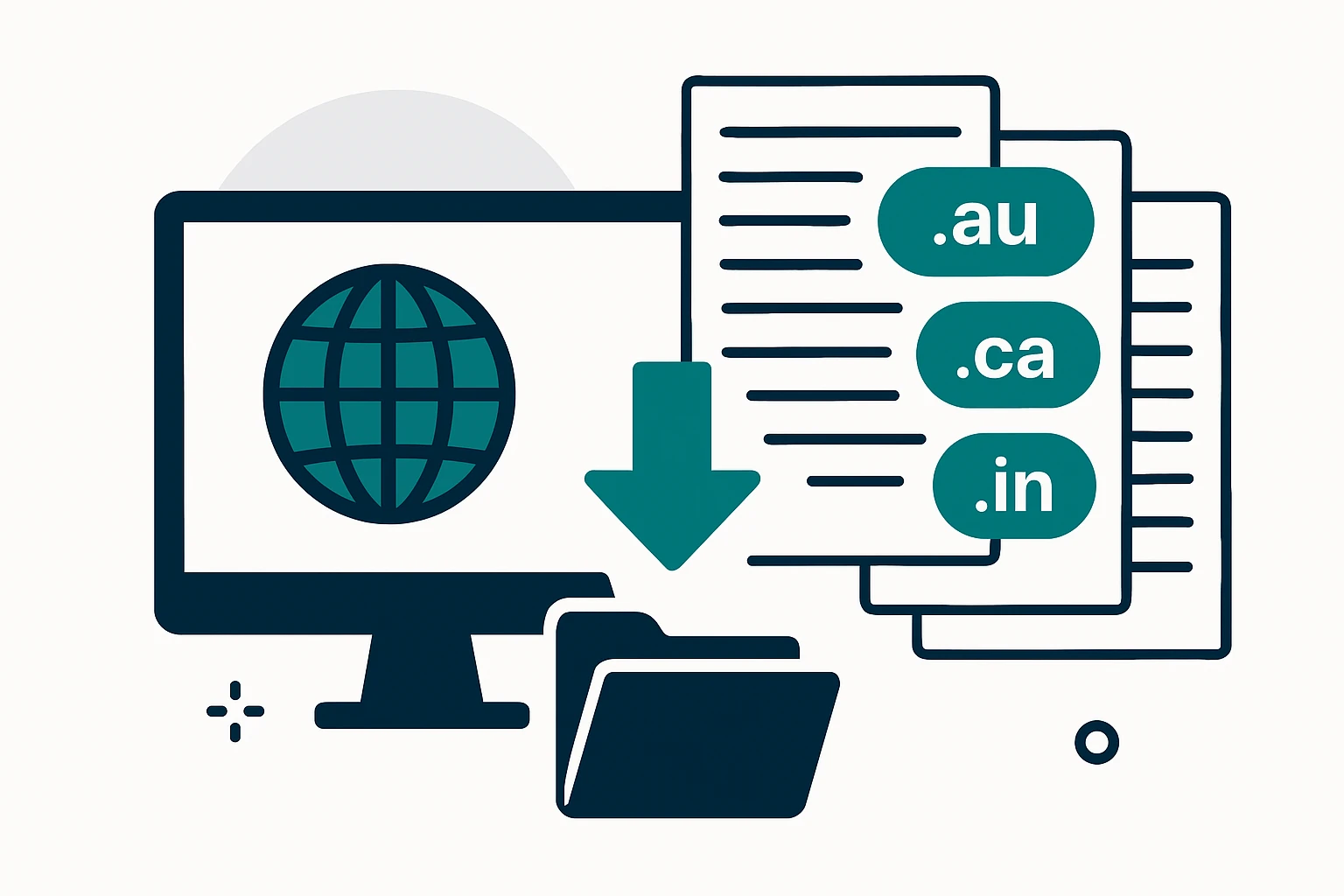
For large-scale DNS operations, the ability to reference bulk domain lists is a strategic capability. Enterprise DNS teams increasingly rely on these datasets to inform security monitoring, policy enforcement, and routing decisions across global infrastructure. In particular, datasets that cover top-level domains (TLDs) like .au, .ca, and .in can provide a comprehensive view of the registered namespace, helping operators identify rogue domains, shadow IT activity, and potential misconfigurations before they impact availability or compliance posture. The key is to obtain these lists in a lawful, ethical, and technically manageable way that aligns with both registry policies and enterprise governance.
Two core pathways exist for bulk domain data: (1) zone files via ICANN’s Centralized Zone Data Service (CZDS) for gTLDs, and (2) registry- and registrar-provided data for ccTLDs or country-specific zones. The CZDS is the centralized portal that enables approved entities to download zone files from participating registries, subject to terms and conditions. Access is role-based and governed by registry-specific agreements and ICANN policy. This model has become the backbone of legitimate bulk-domain workflows for research, security operations, and threat intelligence. (czds.icann.org)
Understanding the landscape: CZDS, policy, and country-code TLDs
ICANN’s Centralized Zone Data Service (CZDS) provides a single entry point for zone files across many gTLDs, with registries electing whether to participate and how access is granted. This centralized mechanism streamlines legitimate access, but it is not universal, some registries require direct engagement or additional agreements. The CZDS model is designed to support responsible use, data protection, and compliance with evolving privacy expectations. For organizations that rely on zone data to feed DNS analytics, configuring a compliant workflow around CZDS access is essential. (czds.icann.org)
Beyond gTLDs, ccTLD data (such as .au) often sits under the purview of national registries. In Australia, auDA policy and related privacy and access rules govern who can view or retrieve domain data, including whois data and zone data in certain contexts. Enterprises should align data procurement with these policies to avoid regulatory or operational friction. Knowing the policy framework helps avoid accidental policy violations and supports a clean, auditable data pipeline. (domainname.gov.au)
What to expect when you download bulk domain lists
Bulk domain data typically comes with structured fields such as domain name, registration status, registrar, creation date, and sometimes DNS resolution metadata. When you request zone files through CZDS, you receive zone data in a format suitable for zone transfers, which must be parsed and validated before use within an enterprise DNS workflow. The data volumes can be substantial, early planning around storage, network throughput, and processing power is essential to avoid bottlenecks. Vendors and registries frequently provide additional value by offering filtered exports, historical views, or API-based access to complement zone files. The result is a data feed you can integrate with threat intelligence platforms, DNS monitoring systems, and governance dashboards. (czds.icann.org)
Licensing, compliance, and ethical use
Downloading and using bulk domain data is subject to licensing and use restrictions. Registry agreements typically specify permissible purposes, rate limits, and data-protection obligations. In the AU context, auDA policies emphasize that data access and use must comply with national rules and privacy considerations, with explicit paths for lawful requests and enforcement-related access. Enterprises should formalize a data-use policy that coversWhois/RDAP data handling, retention, and sharing with internal teams or third parties, and ensure all workflows are auditable for compliance audits (SOC 2, ISO). This disciplined approach reduces the risk of misuse and supports security programs that rely on accurate domain visibility. (auda.org.au)
From raw list to usable intelligence: practical integration steps
Turning a bulk domain list into operational value requires a repeatable data pipeline and a DNS-aware consumption model. Below is a practical approach that many enterprise teams adopt to make bulk domain data actionable while preserving performance and security.
- Clarify the intent and scope. Define whether the data will support threat detection, access control, or traffic steering. Align with compliance requirements and establish governance roles.
- Obtain the data via approved channels. Use CZDS for gTLD zone files where available, and work with registries for ccTLD data (e.g., .au) in accordance with local policies. Establish a documented workflow for access requests and renewal. (czds.icann.org)
- Normalize and enrich. Normalize domain formats, resolve canonical names, and enrich with registration dates, registrars, and known DNS health indicators. Consider augmenting with historical RDAP/whois datasets if needed for trend analysis. (whois-history.whoisxmlapi.com)
- Ingest with guardrails. Implement rate limiting, safe parsing, and validation to prevent pipeline overload. Maintain strict access controls and data retention policies, this protects both the organization and the data subjects represented in the records.
- Integrate with DNS infrastructure. Use the list to inform zone management, traffic steering, and security controls. For example, correlate domain appearances with DNSSEC deployment decisions, anycast routing strategies, and cloud DNS architectures to improve uptime and resilience.
- Monitor and refresh. Establish cadence for updates (daily, weekly) and automate change detection with delta processing so you only re-run what has changed. CZDS and registry feeds often provide update windows, plan around those. (czds.icann.org)
A concrete framework you can apply today
To help teams operationalize bulk domain data, here is a compact, repeatable framework you can adopt. It emphasizes a clear path from data access to DNS-ready intelligence, while keeping a firm lid on compliance and governance.
- Data discovery and licensing – Confirm what data you can lawfully access for your use case and document any usage restrictions, retention windows, and distribution rules.
- Access and procurement – Apply for CZDS access for gTLD zone files, for ccTLDs, engage the registry with a defined business case and compliance posture. (czds.icann.org)
- Normalization and mapping – Normalize domain records, map to internal assets, and deduplicate across datasets. Add metadata such as registrar, creation date, and DNS health signals if available.
- Enrichment and validation – Enrich with threat intel indicators, known bad domains, and cross-check against internal allowlists/denylists. Validate against DNSSEC status and anycast coverage where relevant.
- Consumption and governance – Feed the data into your DNS monitoring, access control tooling, and security dashboards. Establish review cycles for use, access, and retention.
For organizations that manage a global DNS footprint, this pipeline becomes a backbone for visibility and control across cloud and on-prem environments. It also aligns with best practices in data governance and security maturity models, which increasingly emphasize auditable, policy-driven data workflows.
Limitations, trade-offs, and common mistakes
While bulk domain lists unlock significant capabilities, they come with important caveats. Here are the most common missteps to avoid and the trade-offs to consider:
- Over-reliance on zone files for real-time threat detection. Zone files reflect a historical view of the namespace and may not capture rapid changes. Combine zone data with live RDAP lookups and real-time monitors to reduce blind spots. (czds.icann.org)
- Underestimating data volume and processing needs. Zone files for large TLDs can be enormous. Plan for storage, network bandwidth, and compute to avoid bottlenecks in ingestion or analysis.
- Misalignment with regional policies. Access, privacy, and usage rules vary by registry and country. Ensure your procurement contract and data-handling processes satisfy local law and registry terms. auDA policies illustrate the importance of policy alignment for ccTLD data. (domainname.gov.au)
- Ignoring data freshness. If cadence is too slow, you risk working with stale data. Establish a refresh schedule that matches your risk tolerance and DNS operational tempo. CZDS-supported zone files are updated on controlled schedules, plan accordingly. (czds.icann.org)
Where the client fits: integrating domain assets with DNS infrastructure engineering
For DNS infrastructure teams, bulk domain data feeds into a larger ecosystem that includes authoritative DNS, DNSSEC, Anycast, and cloud-native DNS services. The client’s offerings - such as bulk domain datasets by TLDs and country-focused lists - can sit alongside other data sources to enrich visibility and decision-making. Integrating a reputable bulk-domain feed with your DNS platform can help you:
- Improve DNS security posture by correlating domain appearances with known malicious activity.
- Enhance compliance monitoring with auditable provenance trails and policy-compliant data retention.
- Support operational decisions for traffic management and routing across multi-cloud environments.
To explore these datasets directly, the client publishes TLD-focused domain databases such as .au, as well as a broader index of TLDs that can be exported for integration into enterprise workflows. External domain data providers often offer bulk exports (e.g., .au, .ca, .in) and API-based access to complement zone-file data. For organizations evaluating providers, consider the provider’s coverage, licensing terms, and the ease with which their data can be integrated into your DNS architecture. See the client’s AU TLD data page and broader TLD catalog in their site catalog for reference, as well as the pricing page for practical licensing context. Additionally, the CZDS-based workflow described by ICANN remains the foundational approach for legitimate zone-file access. (webatla.com)
Real-world considerations and expert insight
Experts in DNS architecture emphasize the need for disciplined data governance when handling bulk domain data. An industry advisory on CZDS highlights that access and use come with policy constraints and operational considerations that can influence data-lifecycle design, rate limits, and security controls. Implementing a compliant, auditable process is not optional when you operate at enterprise scale. This perspective supports building a robust data pipeline that blends historical zone data with live signals to support resilient DNS operations. (itp.cdn.icann.org)
Conclusion
Bulk domain lists - particularly for .au, .ca, and .in - offer substantial value for enterprise DNS teams, supporting security, compliance, and performance objectives. By engaging through approved channels (CZDS for gTLDs and registry routes for ccTLDs), organizations can assemble a governance-ready dataset that powers DNS monitoring, policy enforcement, and resilient routing architectures. The key is to design a repeatable, auditable workflow that respects licensing, privacy, and local policy while staying aligned with the operational tempo of modern DNS infrastructures. When used thoughtfully, bulk domain data becomes a strategic asset rather than a compliance burden. For teams seeking a practical starting point, combining CZDS access with a disciplined ingestion framework - and pairing it with a trusted data provider - offers a path toward greater visibility and control across the global DNS surface.
Useful starting points and references include the CZDS portal and ICANN’s policy materials, which describe how zone file access works and under what conditions it can be used. For those evaluating providers, the client’s AU-focused data catalog can serve as a practical, scalable source of bulk domain data that complements the CZDS-based workflow. CZDS – ICANN ICANN – Zone File Access auDA – Application of Policy.