Bulk ccTLD Domain Lists for DNS Operations: Why they matter and how to use them responsibly
For large enterprises with distributed infrastructures, bulk lists of country-code top-level domains (ccTLDs) can be a powerful input for DNS policy automation, threat intelligence, and domain discovery. When you operate or audit authoritative DNS, cloud-based resolvers, and security controls across regions, having a broad view of the active domain space in .ua, .fi, and .gr (and other ccTLDs) can accelerate risk assessment and policy enforcement. But bulk ccTLD data is not a turnkey asset. It requires careful handling, verification, and alignment with privacy and security controls. This article outlines a practical approach to obtaining, validating, and using ccTLD domain lists for DNS infrastructure while staying compliant and minimizing operational risk. Expert insight: treat zone-file data as a starting point rather than a complete truth, layer it with real-time registration data and DNS telemetry for a reliable picture of current activity. (czds.icann.org)
What bulk ccTLD domain lists are - and are not
In its simplest form, a bulk ccTLD domain list is a snapshot of domain names registered under a given ccTLD at a point in time. Zone files are the canonical representation of active domains within a TLD, but they are not always directly accessible for every ccTLD. The industry relies on two primary access models: official zone-file access managed by registries (often via registry programs or third-party intermediaries) and data services that compile and deliver enriched records from multiple sources. It’s important to understand that not every ccTLD publishes zone files publicly, and access is typically controlled by the registry or through vetted data providers. ICANN’s Zone File Access ecosystem illustrates how bulk data is distributed for gTLDs and the broader landscape for ccTLDs, which often involves registry-directed access or participation in related data-sharing programs. Centralized Zone Data Service (CZDS) provides bulk access to zone files for many gTLDs, while ccTLD access is managed directly by each registry. (czds.icann.org)
Access models for ccTLD data: what to choose for .ua, .fi, and .gr
Access to ccTLD zone data varies by registry. The CZDS model is well-established for gTLDs, but ccTLDs - such as .ua (Ukraine), .fi (Finland), and .gr (Greece) - are typically governed on a registry-by-registry basis. Some ccTLDs participate in broader security and abuse reporting ecosystems (for example, through ICANN’s DAAR program), while others maintain direct data-sharing arrangements with trusted parties. This landscape means your operational plan should begin with registry-specific inquiries and, where possible, complement with trusted third-party data services that respect privacy and governance requirements. ICANN reports that ccTLD operators voluntarily participate in DAAR or similar initiatives to share threat data and analytics, underscoring the importance of governance and verification when using bulk ccTLD data. DAAR ccTLD program highlights the voluntary nature and the variability across ccTLDs. (icann.org)
A practical workflow: download, validate, enrich, and operationalize
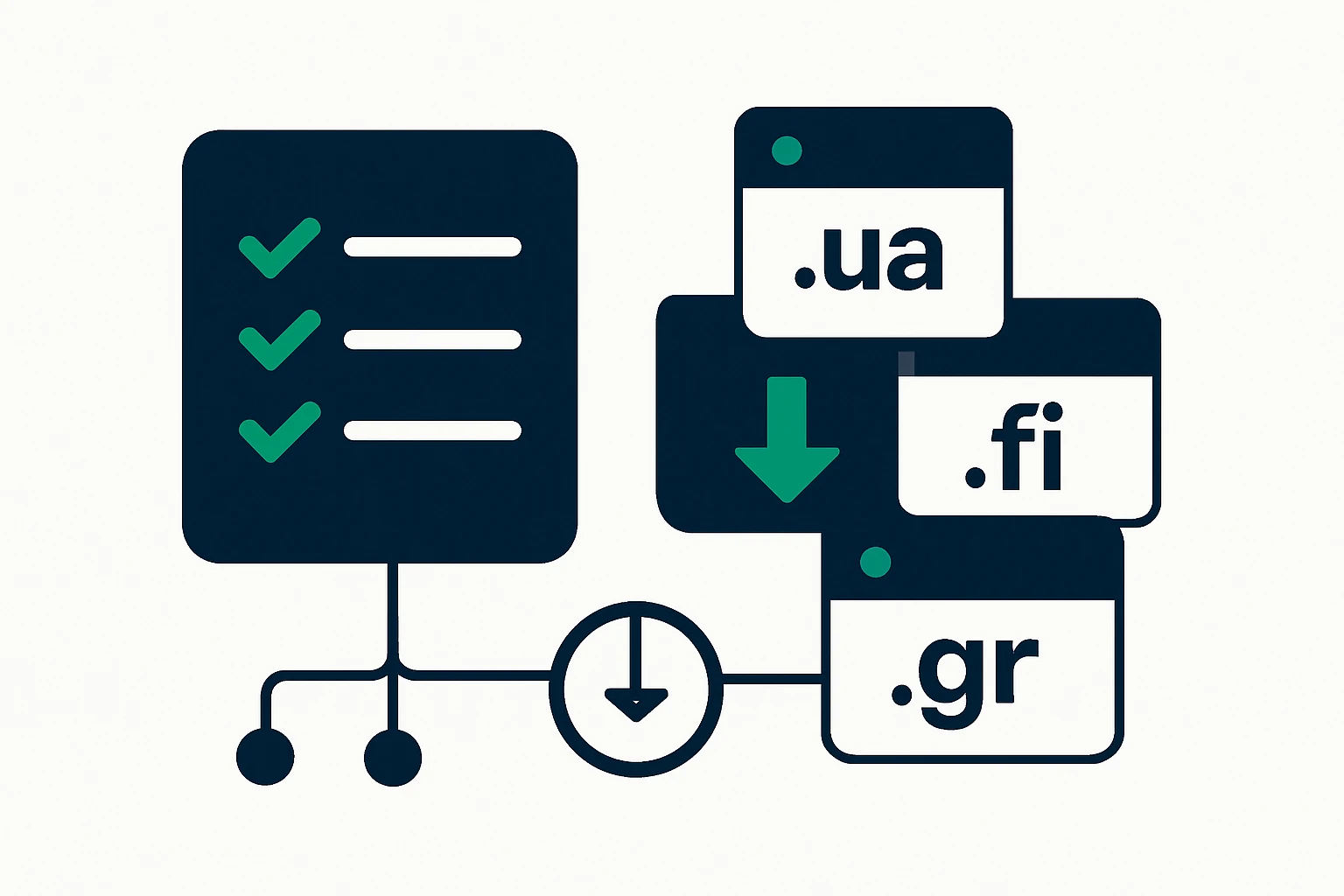
Below is a pragmatic workflow designed for DNS teams that need to work with .ua, .fi, and .gr lists while maintaining governance and data quality. The workflow emphasizes validation, enrichment, and safe integration with existing DNS operations.
- 1) Define use-case and compliance requirements - Clarify whether you are using the data for discovery, threat intel, DNS policy automation, or asset inventory, and map it to privacy and regulatory constraints (e.g., GDPR considerations when handling registration data). The data source should be compatible with your internal data retention and access controls.
- 2) Choose an access path - If available, use registry-provided zone-file access (via CZDS for gTLDs, registries for ccTLDs typically require registry-level arrangements) or rely on a reputable data service that aggregates ccTLD data with appropriate governance. The ICANN CZDS framework and related policy documents illustrate how zone-file access is delivered and governed. CZDS overview (czds.icann.org)
- 3) Validate and deduplicate - Normalize domain names, remove duplicates, and filter out obvious invalid entries. Be mindful that zone files reflect active domain names but can include domains with privacy-protected registrants or dynamic changes. Use additional signals such as registration data (RDAP) to enrich and validate. The combination of zone data with RDAP-style records yields a more reliable picture. DAAR ccTLD context (icann.org)
- 4) Enrich with registration data - Where permissible, enrich domain records with registration metadata (creation dates, status) via RDAP/WHOIS data. This enables better filtering (e.g., newly observed domains) and reduces false positives in monitoring. The RDAP/WHOIS data landscape emphasizes structured, privacy-preserving access, modern RDAP responses support authentication and GDPR-aligned data handling. Zone File Access concepts (icann.org)
- 5) Integrate with DNS operations - Use the resulting dataset to inform DNS firewall policies, monitoring dashboards, and traffic risk scoring. Treat bulk lists as a foundational layer, pair them with real-time DNS telemetry (query logs, DNSSEC validation status, and routing changes) to maintain accuracy and operational usefulness. For enrichment capabilities, consider a data partner that provides daily or near-real-time registration data alongside zone data. DAAR context (icann.org)
A structured framework for procurement and validation
Procurement and Validation Framework (a practical three-layer approach)
- Layer 1 - Sourcing: Acquire zone data via registry-led programs or trusted data vendors with clear data-use terms, focusing on .ua, .fi, and .gr. Where available, prefer sources that publish access policies and data quality metrics.
- Layer 2 - Quality assurance: Normalize formats, deduplicate, and validate against independent signals (RDAP/WIPO-like data, where permissible). Implement change-detection routines to catch deprecations or re-registrations in near real-time.
- Layer 3 - Operational integration: Ingest into a DNS operations workflow, apply to monitoring dashboards, and enrich with polite access controls and data retention policies to meet governance objectives. Consider adding a compliance wash step to ensure data-handling aligns with SOC 2 and ISO standards.
Client integration: enriching bulk ccTLD data with RDAP & WHOIS
For teams seeking to operationalize bulk ccTLD data, external data services can be combined with registration data to improve signal quality and compliance posture. A practical option is to leverage a reputable RDAP & WHOIS dataset that aggregates data from multiple registries and formats it for automated consumption. The RDAP & WHOIS Database provides structured, up-to-date domain registration information, including GDPR-compliant responses and daily updates, which can augment zone-file lists in a compliant workflow. This approach helps DNS operators maintain visibility into domain activity, while preserving privacy controls and data minimization principles. (webatla.com)
Limitations, trade-offs, and common mistakes
Working with bulk ccTLD lists comes with notable caveats. First, zone-file data represents a snapshot and may not reflect rapid changes in domain ownership, takedowns, or re-delegations. Second, many ccTLDs do not publish zone files publicly, and access is regulated by the registry, rely on registry channels and compliant data partners rather than assuming universal access. Third, facially simple datasets can tempt operators to ignore privacy considerations or to treat data as a complete registry view, which is risky for security and compliance programs. To mitigate these risks, pair bulk lists with real-time telemetry and enforce data governance policies from day one. Limitation example: even when zone files exist, they may not capture subdomains or dynamic DNS configurations that could be relevant for security monitoring. Zone File Access concepts (icann.org)
Expert insight and practical caveats
Expert insight: Zone-file data is a powerful starting point for broad visibility, but it is not a substitute for real-time DNS telemetry and registration data. Enterprises that mix zone data with RDAP/WHOIS signals tend to achieve higher signal-to-noise, better timing for security alerts, and more precise policy enforcement. This layered approach helps avoid common pitfalls such as stale data and misinterpreted registrations, which can undermine both security and governance objectives.
Limitations and common mistakes (consolidated)
- Relying on zone files alone to infer ownership or intent of domains (registrant details are often limited or privacy-protected).
- Assuming public ccTLD zone data exists for all regions, many registries restrict access or offer it only under strict terms.
- Using outdated lists without a reliable update cadence, best practices call for near-real-time enrichment where possible.
- Underestimating data governance needs (privacy, retention, access controls) when integrating with SOC 2 / ISO-aligned processes.
Real-world considerations: how to move forward
If your organization needs to work with ccTLD domain lists such as .ua, .fi, and .gr, start with a registry-aware plan that prioritizes governance and data quality. Leverage registry-provided access where possible, and consider partnering with a vetted data service for enrichment and normalization. When applying the data to DNS-infrastructure projects - whether for security monitoring, policy automation, or asset discovery - ensure your architecture supports privacy controls, audit trails, and change management aligned with enterprise standards. For teams exploring vendor options, a careful evaluation of data latency, coverage, licensing, and compliance posture is essential to avoid later friction.
Conclusion: balanced, governance-forward DNS data strategy
Bulk ccTLD domain lists offer meaningful benefits for DNS operations - enabling broader visibility, faster discovery, and improved threat-context for regional DNS policies. The key to success is a disciplined workflow that combines registry- and vendor-provided data with enrichment signals from RDAP/WHOIS, while adhering to privacy and governance practices. In this landscape, a measured, evidence-driven approach delivers the operational value you need without compromising compliance or data integrity.