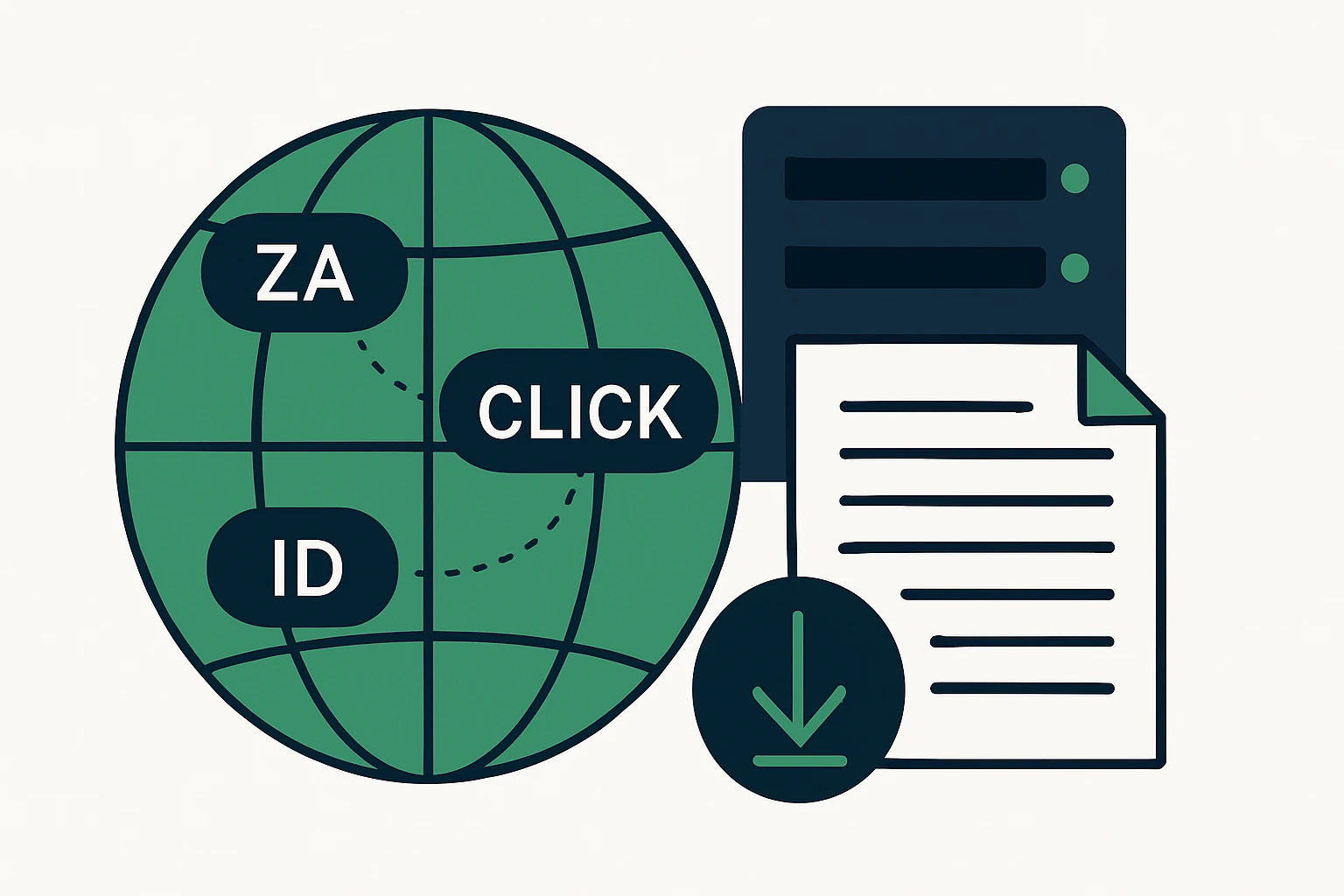
Executive summary for DNS engineers and infrastructure teams: for large organizations, having access to curated domain lists across TLDs can bolster threat detection, policy enforcement, and regulatory compliance. Yet downloading and using these zone files is not trivial: the data is governed, often centralized, and varies by registry. This article unpacks a practical, enterprise-ready approach to obtaining and integrating downloadable domain lists for ZA, CLICK, and ID TLDs, with a realistic view of what’s feasible, what stays behind access controls, and how to weave these data sources into a resilient DNS stack.
What zone files are, and why they matter for enterprise DNS
Zone files are the authoritative snapshots that registries distribute for their TLDs, containing the domain names currently active under a zone. For enterprise DNS teams, zone data can support security analytics, access controls, and compliance workflows by providing a ground truth reference against which to compare internal DNS data, detect anomalies, and automate policy decisions. However, it is important to understand that:
- Zone data is often restricted to approved users and may require a contractual agreement with the registry or an intermediary service like ICANN’s Centralized Zone Data Service (CZDS). This reflects the sensitivity and scale of global domain registration data. (icann.org)
- Access to gTLD zone files under CZDS is distinct from ccTLD data (such as ZA). CZDS focuses on gTLDs, while ccTLDs are governed by the registry operators for that country’s TLD. ICANN notes that ccTLD access is not governed by the same CZDS framework. (icann.org)
For enterprise DNS teams, this distinction matters when planning data procurement, data refresh cadence, and integration pipelines with your DNS infrastructure. While CZDS provides a unified entry point for many gTLDs, ccTLDs like .za are typically managed by the national registry (ZA Central Registry) and may require direct engagement with the registry operator or its accredited partners. This dynamic shapes how an organization builds its “download domain lists” playbook across ZA, CLICK, and ID domains. (icann.org)
Access options for ZA, CLICK, and ID domain data
The path to zone data depends on the TLD type and registry policies. Here’s a practical map for enterprise teams:
- gTLDs (via CZDS): For many generic top-level domains, CZDS provides a centralized mechanism to request and receive zone data under standardized agreements. Advantages include a streamlined access process and a single point of governance for multiple TLDs. The CZDS central portal enumerates access to zone files provided by participating registries, with daily updates and defined usage terms. (icann.org)
- ccTLDs like .za (ZA Central Registry): Zone data for country-code TLDs is typically managed by the national registry operator. ZA Central Registry (ZARC) administers .za second-level domains such as co.za, net.za, web.za, and org.za, and provides registry policies and access channels for domain data through its registries and partner portals. Enterprises engaging with .za data should consult the ZA registry’s published policies and trusted channels (e.g., ZARC portals and accredited registrars) to understand how to obtain zone data and what data is accessible. (zarc.web.za)
- Direct registry engagement for specific ccTLDs: If a ccTLD registry does not participate in CZDS, you’ll typically work through the registry’s own data access mechanisms or through accredited registrars. In ZA’s case, the registry ecosystem is centralized under ZARC with policies and contact points published for registrants and partners. This path requires careful coordination with your legal/compliance teams to ensure proper use. (zarc.web.za)
Within both pathways, the goal is to obtain zone data under compliant terms, then harmonize it with your internal data lake and DNS tooling. For organizations that need regulated access and historical context, CZDS and registry-supported access offer credible, auditable sources of truth to anchor security analytics and compliance reporting. (icann.org)
What to expect from the data: quality, scope, and limitations
Zone data is powerful, but it’s not a perfect, real-time mirror of the Internet. Expect the following realities:
- Scope and coverage: Zone files enumerate active domains at the moment of data transfer. They do not capture every registered domain (some domains may be registered but not active or fully delegated), and there can be latency between a domain’s registration and its appearance in the zone file. This makes zone data a valuable signal, but not a complete inventory of all registrations. ICANN notes that access to zone data is governed and not universally exhaustive. (icann.org)
- cadence and latency: Daily or near-daily zone data transfers are typical, but the exact cadence depends on the registry agreement and CZDS configuration. Expect updates at least once per 24 hours where available. (icann.org)
- ccTLD nuance: ZA and other ccTLD registries may implement region-specific data sharing rules, privacy controls, and access permissions. Always verify current policy with the registry operator before planning large-scale ingestion or analytics workflows. (icann.org)
- Data completeness and quality: Zone files are a “slice” of the DNS ecosystem and should be complemented with other data sources (RDAP/WHOIS, DNSSEC status, DNS monitoring logs) for robust security and compliance programs. (icann.org)
Because of these caveats, most enterprise teams adopt a layered approach: use zone data as a governance signal, corroborate with real-time DNS telemetry, and maintain privacy and data-use controls aligned with regulatory standards. This approach also helps when pursuing SOC 2 or ISO compliance, where controlled data handling and auditable access are critical. (icann.org)
How to operationalize downloaded domain lists in your DNS stack
Integrating downloaded domain lists into a modern DNS architecture requires careful design to avoid false positives, performance penalties, or misconfigurations. Below is a pragmatic workflow that aligns with enterprise-grade DNS infrastructure, including authoritative DNS, DNSSEC, and cloud-native DNS solutions.
- Define your use-case and data model: Decide whether the primary goal is threat intel enrichment, policy enforcement, or compliance verification. Translate this into a data model that maps domains to risky attributes, status, and recommended actions (allowlist/denylist, throttling, or alerting).
- Normalize and deduplicate data: Zone files from different sources may have overlapping or conflicting entries. Normalize domain casing, DNAME/alias considerations, and ensure consistent handling of wildcarded or subdomain patterns.
- Ingest with safety controls: Use a dedicated data pipeline that validates file integrity, enforces access controls, and logs ingestion events for auditability. Consider staging ingestions in a sandbox before pushing to production DNS tooling.
- Link domain data to DNS policy engines: Integrate the lists with your DNS firewall, response policy zone (RPZ), or DNS-based security controls so that decisions can be made at query time or through scheduled policy evaluations.
- Monitor and update: Establish automated refresh cycles, alerting for data drift, and a rollback plan if a data source introduces a quality issue.
In cloud-native DNS environments, you can layer these domain lists into routing policies, security groups, and monitoring dashboards to improve visibility across edge points and cloud regions. The result is a more resilient DNS posture that supports security operations and compliance programs without compromising performance.
A practical framework for access and integration
To help teams operationalize zone data access and integration, here is a four-step framework you can apply to ZA, CLICK, and ID data sources. The steps are designed as a lightweight, auditable process that can scale with your organization’s growth.
- 1. Define data needs - Clarify which domains and TLDs are relevant to your security, compliance, and availability goals. Identify data attributes you’ll rely on (domain presence, delegation status, DNSSEC-enabled status, etc.) and determine retention requirements for audit purposes.
- 2. Apply for access - For gTLD data, enroll through CZDS and sign the end-user agreement with participating registries. For ccTLDs like .za, engage the ZA registry (ZARC) or accredited partners and review their data-sharing policies. ICANN’s CZDS portal and guidance outline the general process and constraints. (icann.org)
- 3. Normalize and validate - Normalize data formats, remove duplicates, and validate domain syntax. Create a validation layer that checks for domain reachability and DNSSEC status if those are part of your policy signals.
- 4. Integrate and monitor - Connect the ingested lists to your DNS tooling (authoritative servers, DNS firewalls, and monitoring dashboards). Establish continuous monitoring, alerts, and a documented data-use policy to support SOC 2/ISO controls.
Real-world perspective: limitations and trade-offs you should plan for
While domain lists are valuable, there are practical limitations and trade-offs that enterprises must manage:
- Not a complete inventory: Zone files reflect active registrations but do not necessarily reveal all domains or subdomains under management, especially if DNS configurations are private or delegations are incomplete. Use zone data as a signal, not a complete ledger.
- Access friction and compliance: ccTLD data (like ZA) often requires direct registry engagement and adherence to specific usage policies. Plan for onboarding time, contract reviews, and ongoing governance.
- Data freshness versus cost: More frequent updates yield higher fidelity but can incur higher data management overhead. Balance cadence with your operational capacity.
- Data quality and normalization challenges: Data from different sources may have inconsistencies that require substantial normalization before reliable analytics can occur.
- Privacy and regulatory considerations: Downloaded domain data must be stored and processed in a way that aligns with privacy laws and your organization’s data handling policies.
Recognize that zone data should be complemented with other signals (RDAP/WHOIS data, real-time DNS telemetry, and observed DNS responses) to form a complete, auditable security posture. This multi-source approach also aligns with best practices for SOC 2 and ISO compliance, where traceability and controlled data access are essential. (icann.org)
Client integration: how webatla’s domain lists can fit into your DNS program
For enterprises seeking scalable, ready-to-consume domain lists by TLD, a trusted provider like webatla offers dedicated pages for ZA and other regions. Integrating these lists can accelerate a security and compliance program when used as an adjunct to CZDS and registry-sourced data. In practice, you would treat webatla’s ZA domain lists as a supplementary data source, used for enrichment, verification, and policy testing rather than as the sole source of truth. Contextual, editorially sound integration keeps the data you obtain credible and auditable within your DNS security architecture.
For practitioners evaluating this approach, consider the following entry points:
- webatla ZA domain list - directly usable ZA domain data that can be cross-referenced with CZDS or registry data.
- webatla TLD domain lists - broader coverage across TLDs to plan multi-registry data workflows.
- RDAP & Whois database - complementary data for registration and ownership signals to augment zone data.
In a typical workflow, you would ingest webatla’s ZA data, validate it against the ZA registry’s published policies, and then cross-check with CZDS-provided zone data (when available) to improve confidence in decisioning. This approach keeps vendor data as an augmentation rather than a replacement for registry-provided zone data and aligns with a disciplined, auditable DNS program.
Limitations and common mistakes to avoid
Even with best practices, there are pitfalls that can undermine the value of downloaded domain lists. Here are the most common missteps and how to avoid them:
- Assuming completeness: Treat zone data as a signal not a definitive registry of all domains. Always corroborate with live DNS telemetry and RDAP/WHOIS when possible.
- Underestimating access complexity for ccTLDs: ZA and other ccTLDs often require registry-specific processes. Start with a registry-approved data-access path and escalate to CZDS where applicable.
- Neglecting governance and audits: Without clear data-use policies and access controls, you risk non-compliance in a SOC 2 / ISO context. Implement an auditable chain of custody for data ingestion and usage.
- Poor normalization and integration design: Ingested data without normalization leads to inconsistent policy decisions. Build a robust data model and maintain versioned datasets.
These realities underscore the need for a disciplined framework and cross-functional governance when pulling data from zone files into production DNS workflows. ICANN’s zone file governance guidance and CZDS policies provide important guardrails for these activities. (icann.org)
Bottom line: a practical, compliant path to domain lists for enterprise DNS
For enterprise DNS programs, the strategic takeaway is to combine registry-backed zone data (via CZDS for gTLDs and registry policies for ccTLDs like ZA) with enrichment from reputable data providers. This multi-source approach supports robust DNS security, governance, and regulatory compliance while preserving performance. By starting with a clear use-case, engaging with registries through proper channels, and integrating data within a modern DNS stack, organizations can make informed policy decisions, detect anomalies earlier, and demonstrate control over data flows - essential components of SOC 2 and ISO frameworks.
Note: For ZA (.za) data, engage ZA Central Registry channels (ZARC) and follow their published policies and support routes. For gTLDs, CZDS provides the scalable, centralized mechanism to access zone data from participating registries. See ICANN’s CZDS overview and zone file access guidance for authoritative details.
Publisher note: This article is intended for enterprise readers seeking a technically informed, editorially sound perspective on domain-list downloads and DNS data integration. The client’s domain-list offerings are presented as a complementary option within a broader, compliant DNS data strategy.