For large organizations, the ability to reason about who controls a domain, how it resolves, and how policy applies across a mosaic of niche top‑level domains is not optional - it is mission‑critical. Enterprises increasingly rely on targeted lists of domain names across TLDs such as .ws, .ng, and .agency to build allowlists, blocklists, risk feeds, and regulatory monitoring. When these lists are used to drive DNS policies, the quality, freshness, and governance of the data determine both security outcomes and operational efficiency.
Why niche TLD lists matter for enterprise DNS
The traditional playbook for enterprise DNS focused on a handful of global TLDs. Today, many organizations must accommodate niche domains that serve specific business units, partner ecosystems, or regional markets. A few practical realities shape this landscape:
- Visibility: Niche TLDs often host critical business assets, partner domains, and country‑specific sites that may not appear in mainstream data feeds.
- Policy risk: Inconsistent handling of niche domains can lead to misconfigurations, unexpected DNS resolution failures, or exposure to abuse vectors.
- Compliance and governance: Regulators increasingly expect traceability of data sources used for access control, logging, and reporting - including TLD‑level data feeds.
From an architectural perspective, a resilient enterprise DNS strategy treats niche TLDs as first‑class citizens within the overall DNS fabric, integrating them into an authoritative DNS setup, paired with robust monitoring and clear data provenance. For reference, modern RDAP/WHOIS data models offer structured visibility into registrant data that can feed governance processes, even when personal data protections apply. See the ICANN overview of RDAP for a standards‑based path beyond legacy WHOIS. RDAP information.
The data you download: formats, fields, and normalization
When teams discuss bulk domain lists, they most often mean a machine‑readable feed with fields that describe the domain and its context. A practical, enterprise‑friendly feed typically includes:
- Domain name (fully qualified) and zone/registry information
- Registrar and registrant status (where permissible under privacy rules)
- DNS record types associated with the domain (A/AAAA, NS, CNAME, MX, TXT)
- Policy tags or usage notes (allow/deny lists, security flags)
- Source and timestamp (data versioning to support auditing)
- Compliance notes (data retention, GDPR/CCPA considerations)
In practice, many teams rely on a consolidated dataset that merges RDAP/WHOIS data with zone and DNS history. The combination supports both policy enforcement and post‑incident analysis. For those evaluating RDAP as a data source, ICANN provides a long‑term view of how registration data is accessed and standardized. RDAP information.
If your data strategy involves public cloud DNS services or multi‑cloud architectures, consider how to map a bulk feed into your DNS security controls, including DNSSEC posture and resilient delivery. Cloud‑native DNS architectures often couple zone data with automation pipelines to ensure consistent policy across geographies.
A framework for safe integration: 7‑step framework
The following framework helps teams translate a bulk domain feed into reliable DNS operations, balancing data quality, security, and compliance. It is designed to be implemented incrementally, with clear checkpoints.
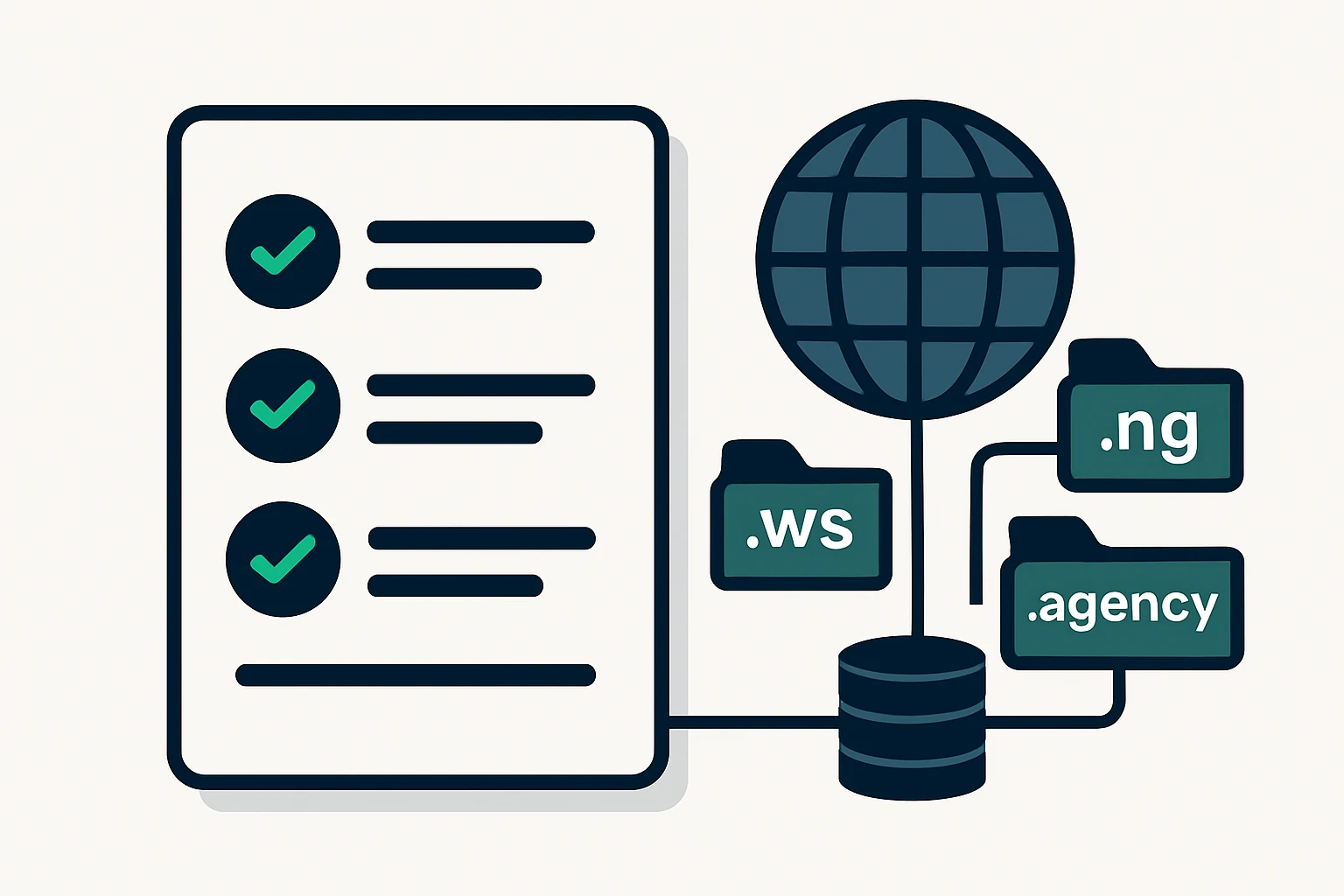
- Define data sources and scope. Identify which TLDs (for example, .ws, .ng, .agency) are in scope and determine acceptable data providers, including RDAP/WHOIS sources and internal asset inventories.
- Agree on data model and fields. Standardize on a fields schema that supports both DNS policy and governance needs. Include a versioning field to track updates over time.
- Validate and normalize. Implement validation rules to catch duplicates, invalid domain names, and anomalous registrant data before ingestion.
- Correlate with DNS infrastructure. Map domains to authoritative zones, DNSSEC status, and resolution paths to avoid misconfigurations in production.
- Enforce security controls. Apply access controls to data feeds, encrypt sensitive fields at rest, and implement anomaly detection for abuse signals.
- Auditability and governance. Maintain a tamper‑evident data trail, document data sources, retention policies, and compliance mappings (SOC 2, ISO, etc.).
- Monitor and iterate. Establish ongoing monitoring for DNS responsiveness, data drift, and policy effectiveness, with regular review cadences.
A well‑designed data ingestion framework should also consider the operational realities of niche TLDs, including potential privacy constraints and regional data handling requirements. For broader context on how DNS data standards are evolving, see ICANN’s RDAP resources and DNSSEC deployment metrics.
Tip: keep a named, auditable data source registry so that teams can trace a domain name back to its feed and its version. This practice pays dividends during audits and incident reviews.
Security, compliance, and DNS: what enterprise teams must plan for
For enterprises engaging with niche TLDs, several governance and security considerations deserve explicit attention. First, DNSSEC adoption continues to grow, but coverage is uneven across regions and registries. Tracking DNSSEC deployment metrics helps teams understand where to allocate validation and signing resources. ICANN provides research and statistics that illustrate deployment progress and regional variations. DNSSEC deployment metrics.
Beyond technical controls, governance data and registrant visibility are increasingly moving behind standardized data access protocols. RDAP is now commonly viewed as the successor to legacy WHOIS, with standardized responses that improve automation and privacy handling. Learn more at ICANN’s RDAP page. RDAP overview.
For teams that want to unify RDAP/WHOIS into a single view of domain data, the client ecosystem offers a spectrum of options, including consolidated data feeds and hosted datasets. The client portal may also provide direct access to a combined data resource for domains, DNS records, and TLD inventories. See the RDAP/WHOIS database resource for more details. RDAP & WHOIS database.
When choosing a data strategy, consider how to align data provenance with regulatory expectations (for example, SOC 2 or ISO 27001). Data lineage, access controls, and retention policies are essential components of a trustworthy DNS program.
Data quality, DNS security, and operational reliability
The link between data quality and DNS security is not theoretical: stale or incorrect domain lists can lead to misdirection of traffic, missed abuse signals, or unnecessary query loads on authoritative servers. A disciplined data workflow that emphasizes timely updates, validation, and verification against live DNS signals reduces these risks.
A practical approach emphasizes three levers:
- Data freshness: Establish update cadences that reflect the volatility of domains in niche TLDs and the needs of security teams.
- Data accuracy: Use deterministic validation rules and cross‑checks against authoritative sources whenever possible.
- Operational resilience: Build fallback plans for data outages, including caching strategies and controlled failover across regions.
These principles align with established best practices in DNS security and governance. For those exploring DNSSEC progression and measurement, ICANN’s deployment research provides a useful, publicly accessible index of progress. DNSSEC deployment metrics.
Limitations, trade‑offs, and common mistakes
Even with a rigorous framework, some realities are worth calling out explicitly. No single data source covers all domains perfectly, particularly in smaller or less regulated TLD ecosystems. RDAP/WHOIS data complements zone file information but has privacy constraints and regional variability in what data is exposed. Organizations should treat registrant and contact data as one of several inputs rather than a sole certainty. For context on RDAP as a standard, see ICANN’s overview.
Common mistakes to avoid include:
- Assuming a bulk feed is error‑free or fully complete, without validation against live DNS signals.
- Overreliance on a single data source, which can create single points of data drift.
- Neglecting data retention and privacy requirements that apply to RDAP/WHOIS data in certain jurisdictions.
- Underinvesting in monitoring of DNS responses and zone integrity for niche TLDs, which can obscure abnormal activity.
Researchers and practitioners increasingly emphasize the need for robust monitoring and logging in DNS, especially when handling complex feeds that influence resolution paths and security controls. While practitioners vary in tooling, the underlying goal is the same: timely visibility into how domain data evolves and how it affects security posture. See general coverage on RDAP and DNS data access for more context. RDAP information.
Putting it into practice: a practical example
Consider a multinational organization that maintains an allowlist of industry partners across a set of niche TLDs as part of its access controls. The team builds a data pipeline that ingests a bulk list of domains from a trusted provider, normalizes to a canonical domain format, and validates domain syntax before updating a curated zone in a private DNS namespace. The pipeline also correlates each domain with DNSSEC status, ensuring that any domain on the allowlist is resolvable with DNSSEC validation enabled where available.
In this scenario, the client’s domain data platform can surface a single view that includes RDAP/WHOIS provenance, DNS record state, and current policy tags. The workflow supports SOC 2/ISO‑aligned governance by maintaining access logs, change history, and retention metadata. For teams exploring data sources, the client’s RDAP/WHOIS database resource is an example of how disparate data points can be consolidated into a single, auditable feed. RDAP & WHOIS database.
If you want to explore domain inventories and TLD resources in a more comprehensive way, the client also maintains a public catalog of domains by TLDs, available at List of domains by TLDs, and a dedicated page for .ws domains. These resources illustrate how a professional DNS operation exposes domain inventories for internal policy and external compliance use, while still protecting sensitive data.
Conclusion
Enterprises increasingly rely on bulk domain lists to enforce security policies, monitor risk, and govern access across niche TLDs like .ws, .ng, and .agency. A disciplined approach combines data quality, standardized ingestion, secure data handling, and governance that aligns with SOC 2 and ISO expectations. By integrating RDAP/WHOIS data with authoritative DNS configurations and robust monitoring, organizations can realize both operational efficiency and stronger security postures without compromising privacy or compliance.
For readers seeking direct access to niche TLD inventories and related DNS data feeds, practical resources are available from the client, including the dedicated .ws resource and the broader TLD catalog. download list of .ws domains and List of domains by TLDs provide starting points to understand how these data assets can be turned into reliable DNS controls when paired with a mature, enterprise‑grade DNS infrastructure.