Introduction: Why bulk domain lists matter for enterprise DNS
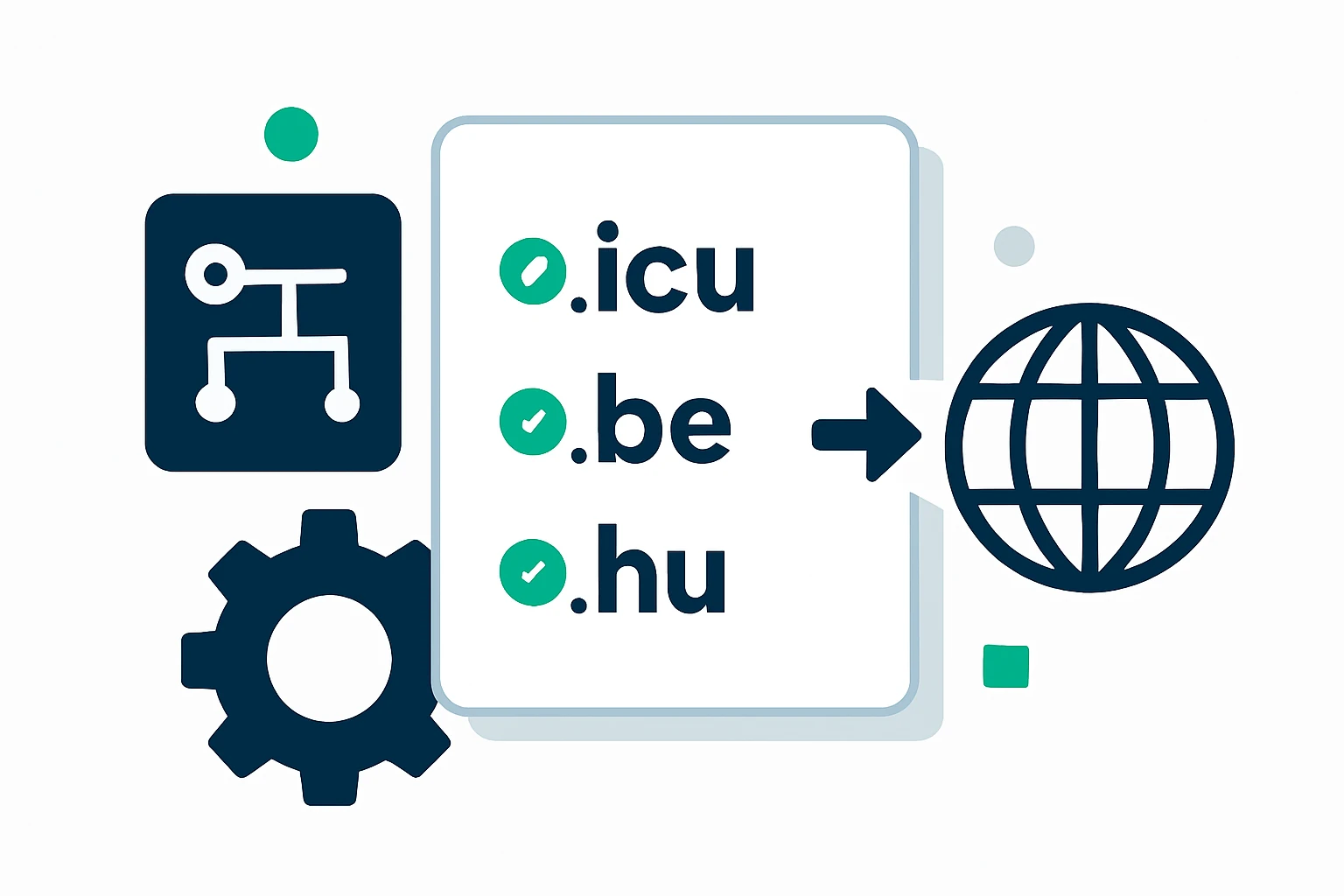
Growing enterprises often manage dozens to hundreds of domains across multiple top-level domains (TLDs). For large organizations, bulk domain lists are not just a procurement exercise, they underpin brand protection, threat intelligence, regulatory compliance, and operational resilience. This is especially relevant when portfolios include diverse TLDs such as .icu, .be, and .hu, which are increasingly used in global branding and regional campaigns. The ability to ingest, harmonize, and apply policy across these domains requires an architectural approach that harmonizes centralized governance with distributed execution at the edge.
In practice, enterprises need to convert bulk domain data into actionable DNS configurations - without sacrificing performance, security, or compliance. This article provides a field-tested perspective on how to design, operate, and optimize enterprise-grade DNS when bulk domain lists, including niche TLDs, are part of the engineering remit. For readers seeking domain-list resources, see the ICU domain catalog at ICU domain lists and the RDAP & WHOIS database for domain provenance at RDAP & WHOIS database.
Section 1: Understanding bulk domain lists and their enterprise value
Bulk domain lists serve multiple purposes beyond mere registration checks. They are foundational for brand monitoring, cyber threat intelligence, and DNS policy enforcement across a distributed ecosystem. When you operate a variety of TLDs, you gain visibility into brand squatting, domain impersonation attempts, and registration lifecycle risks that could affect customers and partners. Industry observers emphasize that bulk portfolio analysis - often fed by RDAP, WHOIS, and DNS data - enables safer domain ownership and faster incident response.
Key takeaways for enterprise teams include:
- Portfolio visibility enables proactive risk management, including renewals, expiry alerts, and domain defense. RDAP and WHOIS tooling help verify ownership, status, and contact information across portfolios.
- Knowledge of DNSSEC status across zones informs cryptographic protection and key-management planning, critical for risk-averse organizations.
- Monitoring and logging across the entire domain portfolio supports forensics, compliance reporting, and performance optimization.
From a governance perspective, reputable standards bodies and security researchers emphasize the need to balance automation with strong controls around key material and policy enforcement. DNSSEC, in particular, is a mature standard whose baseline features and deployment challenges are well documented. For a technical grounding, see the DNSSEC standardization work in RFC 4033 and related documents.
External reference: RFCs governing DNSSEC establish the core security guarantees and operational requirements for signing zones and validating responses. See RFC 4033 for an introduction to DNSSEC concepts and the security requirements it imposes on zone operators.
Section 2: Designing an architecture for bulk domain lists
Centralized governance with distributed execution
Enterprises typically combine a central portfolio registry with automated deployment pipelines to push zone configurations to multiple authoritative DNS servers. This reduces the risk of drift between zones and ensures uniform policy enforcement (for example, DNSSEC enabling, TSIG-based signing, and consistent logging). A cloud-native or hybrid approach can provide scale, while an on-premises–style DNS security posture preserves control over sensitive keys and critical configurations.
For architecture reference, leading DNS providers advocate a global, highly available deployment model that leverages Anycast for resilience. An Akamai white paper argues that Anycast architectures enhance availability and DDoS resilience by distributing responses across multiple global locations, making it harder for adversaries to take down a service and improving latency for end users. Designing DNS for Availability and Resilience discusses the core benefits of Anycast in authoritative DNS.
DNSSEC and automation at scale
Managing DNSSEC across hundreds of zones is nontrivial. Best practices call for automated key management, secure storage, and routine rollover processes to prevent outages or signature validation failures. The DNSSEC ecosystem has matured since RFC 4033–4035, and modern operators emphasize automation as a best current practice to avoid manual mistakes. For a technical baseline, refer to RFC 4033 and related RFCs for the formal framework, and consult industry commentary on automation and key-rotation strategies.
Practically, automation means: (1) regular key-rollover cadences, (2) secure key storage and access controls, and (3) automation testing of DS records and chain validation before production deployment. Authoritative providers increasingly offer APIs and tooling to streamline DNSSEC workflows across large portfolios.
External reference: RFC 4033–4035 establish the structure of DNSSEC, while modern practitioner sources discuss automation as a best practice for scalable, reliable deployments.
Section 3: Operational practices for bulk DNS management
Monitoring, logging, and observability
Operational visibility across a bulk domain portfolio is a baseline requirement for reliability and security. Centralized DNS query logging, anomaly detection, and performance dashboards allow operators to detect resolution failures, misconfigurations, and anomalous query patterns that may indicate abuse. Cloud-native DNS services provide built-in logging and metrics that can feed SIEM pipelines for security investigations and compliance reporting. For example, Google Cloud DNS describes its logging and monitoring capabilities for public and private zones, including per-query data volumes and the scope of logs generated.
In practice, teams should design logging to be actionable rather than encyclopedic: capture essential metadata (domain, query type, response code, timestamp, source context), retain logs for an appropriate retention period, and route them into a centralized analytics or SIEM system to support incident response and compliance reviews.
Similarly, industry guidance emphasizes avoiding common logging pitfalls - such as data fragmentation, lack of correlated visibility, or overwhelmed storage - by adopting a structured logging strategy and centralizing data. See DNS logging best practices and pitfalls in industry writing that highlights how to avoid gaps in visibility and performance issues.
Operational note: for teams leveraging a broad domain portfolio, cross-cloud logging and standardized alerting are essential to maintain a consistent security and performance posture across all zones.
Performance, availability, and cost considerations
Performance and cost are intertwined when managing bulk domain lists. Anycast DNS, edge-based resolution, and cloud-native architectures can reduce latency and improve resilience, but they also introduce management complexity and potential cost considerations as you scale. Providers with global edge networks often publish architecture guidance that highlights the trade-offs between control, cost, and resilience. See Akamai’s architecture guidance for availability and resilience associated with DNS and anycast deployments.
Section 4: Governance, compliance, and risk management
Governance and regulatory compliance are critical when domains span multiple geographies and regulatory regimes. SOC 2 and ISO 27001-type controls frequently underpin client assurance programs for DNS services, especially when combined with cloud-native or managed DNS providers. While the DNS ecosystem is not a single regulatory regime, practitioners emphasize consistent policy enforcement, privacy considerations, and auditable change-management processes across the portfolio. The OECD report on DNS security and governance provides a broad policy-centric perspective on how authorities and operators collaborate to safeguard the ecosystem while enabling legitimate use.
Pragmatic compliance practices include maintaining an up-to-date inventory of domains, validating zone signing status, and documenting incident response procedures tied to DNS events. Collectively, these practices help support audits and third-party risk assessments.
Section 5: Limitations, trade-offs, and common mistakes
No architecture is perfect, especially when managing bulk domain lists across multiple TLDs. Here are the most frequent limitations and mistakes to avoid:
- Underestimating the volume of DNS logs and failing to implement centralized log aggregation and retention policies. Centralized logging reduces time-to-detection for abuse and outages.
- Overlooking secret/key management when rolling DNSSEC signatures across hundreds of zones. Automated key management with secure storage is essential to avoid outages.
- Assuming anycast alone provides load balancing. Anycast improves availability but is not a substitute for proper traffic engineering and zone-level configuration.
- Inconsistent policy enforcement across zones, leading to drift in DNSSEC status, TTL strategies, or access controls.
- Neglecting portfolio hygiene, such as incomplete RDAP/WHOIS data or stale registrations, which can create governance gaps during audits.
These limitations are widely discussed in practitioner literature and highlight the need for disciplined, repeatable workflows when scaling DNS for enterprise-grade needs.
Structured framework: a practical three-tier approach
Below is a compact framework you can customize for enterprise DNS operations dealing with bulk domain lists. It combines governance, security, and observability into a reusable blueprint that aligns with the publisher's focus on enterprise-grade DNS engineering.
maintain a centralized inventory of all domains, track RDAP/WHOIS data, monitor renewal timelines, and set ownership policies. apply DNSSEC consistently, automate key management and rollover, enforce consistent signing and DS records, and standardize zone templates across all domains. centralize DNS logs, implement alerting across zones, integrate with SIEM and incident-response playbooks, and perform regular tabletop exercises for DNS failure scenarios.
For readers exploring bulk domain portfolios, this three-tier approach helps translate a list of domains into a repeatable, auditable, and scalable DNS operating model.
Section 6: Client integration: how this applies to ICU/.icu/.be/.hu domain lists
For organizations that deal with bulk domain lists in niche TLDs - such as .icu, .be, and .hu - operational discipline matters more than raw scale. The client’s ICU listing and RDAP/WHOIS database resources can be used to validate ownership, verify status, and inform risk tagging across the portfolio. The ICU domain catalog is a concrete example of how a brokered, bulk approach can be aligned with enterprise DNS practice: central portfolio governance, policy-driven zone management, and robust monitoring across zones.
As you plan your bulk-domain strategy, consider pairing the ICU portfolio with a scalable DNS architecture (authoritative DNS, DNSSEC, and Anycast) and an observability layer that can handle multi-TLD traffic. If you need to explore domain lists and related data, you can consult the ICU domain catalog and RDAP/WID data page cited earlier.
Conclusion: turning bulk domain lists into a reliable DNS backbone
Bulk domain lists are a necessary ingredient for modern enterprise DNS, but they only deliver value when paired with a disciplined architecture, automation, and observability. By combining centralized governance with distributed, high-availability execution - using DNSSEC where appropriate, leveraging Anycast for resilience, and maintaining comprehensive logs for compliance and incident response - organizations can turn a sprawling domain portfolio into a secure, auditable, and efficient DNS backbone. The end state is a robust, scalable foundation that supports security, compliance, and performance across the globe.
For further exploration of bulk domain portfolio capabilities and domain data resources, consider the ICU portfolio and the RDAP/WHOIS database as practical starting points for an enterprise-grade DNS program.