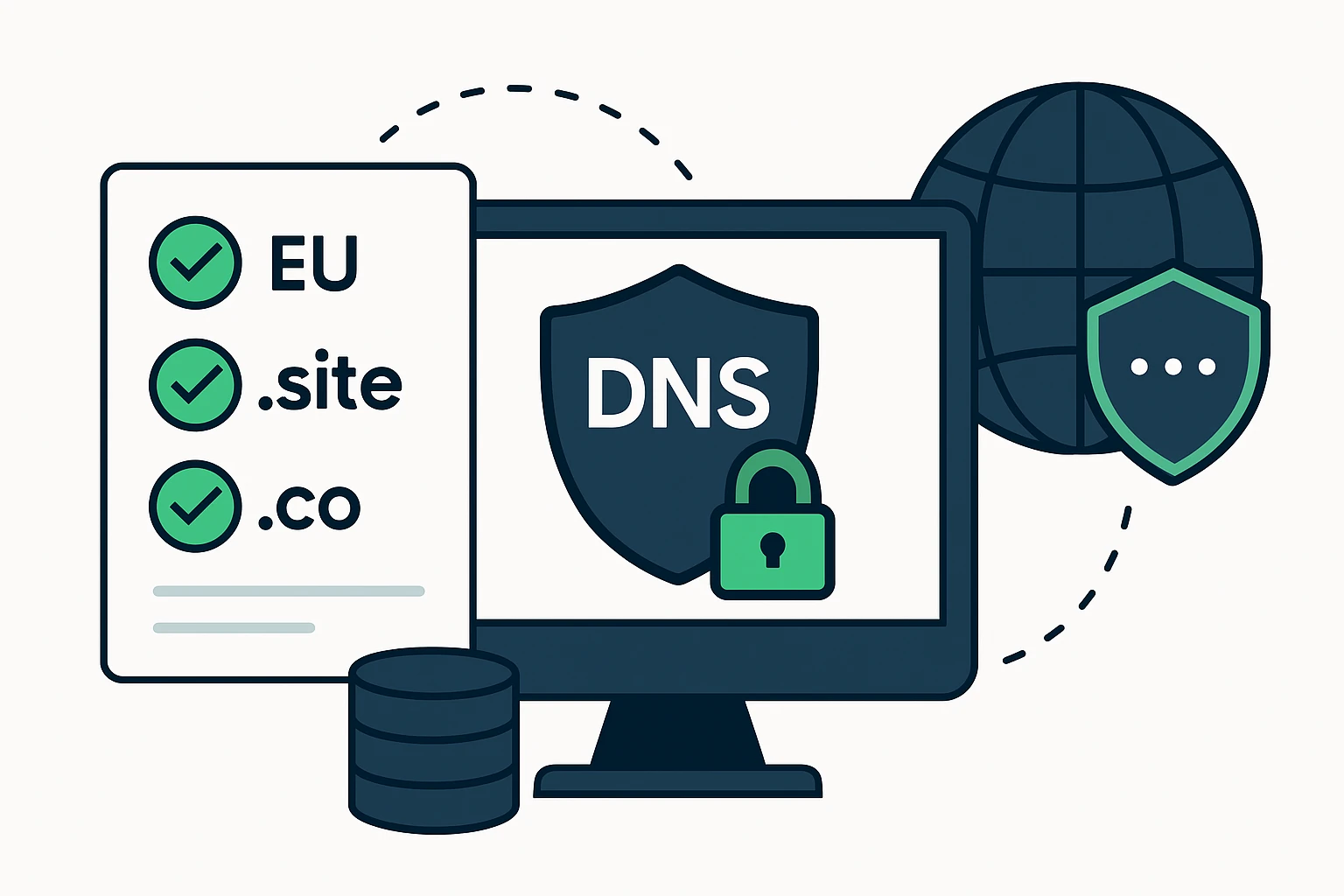
In global enterprises, DNS is more than a technical utility - it is a governance layer that touches security, compliance, and operational resilience. As organizations scale across regions, the number of domains to manage grows rapidly, creating a need for trustworthy domain inventories that can feed DNS configurations, policy enforcement, and threat monitoring. One practical way to operationalize this is by using downloadable domain lists for specific top-level domains (TLDs) such as EU, .site, and .co. These lists support disciplined asset management, help automate change control, and reduce the risk of misconfigurations that can lead to outages or security gaps.
Why downloadable domain lists matter for enterprise DNS
Large organizations typically operate across multiple geographies and cloud environments. Keeping an up-to-date inventory of domains enables several critical outcomes: automated validation of DNS configurations against a known asset set, faster detection of anomalous registrations or transfers, and tighter alignment with regulatory expectations for data governance and privacy. When teams standardize on curated lists - for example, a verified EU domain set or a catalog that includes popular global business domains - they reduce guesswork and accelerate secure rollout of DNS changes across authoritative servers, recursive resolvers, and cloud-based DNS services.
Understanding the target domains: EU, site, and co
The EU (.eu) namespace represents a regionalized asset class with specific governance considerations, including data localization and regional threat exposure. The .site and .co namespaces have gained popularity among startups and regional brands and often serve as marketing or regional presence domains. For enterprise DNS operations, these three categories offer a practical spectrum for illustrating inventory workflows, because they cover regulatory considerations (EU domains in particular) and common business footprints. Maintaining distinct lists for each category helps with targeted monitoring, role-based access controls, and region-aware DNS routing strategies when combined with modern cloud DNS architectures.
How to download and validate domain lists: a practical workflow
Downloading domain lists is only the first step. The value comes from how you validate, normalize, and enrich the data, and how you integrate it into your DNS workflows. Below is a pragmatic workflow that aligns with enterprise DNS governance goals:
- Discover and source: identify reputable providers offering downloadable domain lists for the target TLDs. Ensure licensing permits use in enterprise DNS workflows and that the data is current and well-structured.
- Validate provenance: confirm the data source, update cadence, and the scope of domains included. Validate against RDAP/WORLD data to confirm authoritative ownership where applicable. See RDAP as the standard data access protocol for domain registrations.
- Normalize format: convert to a consistent schema (for example, CSV with columns like domain, registrant, registration date, and status) and standardize domain casing and punycode where needed.
- Enrich and correlate: augment with metadata such as region, registrar, and DNS relevance (eg, whether a domain should be managed within a specific DNS zone or cloud environment).
- Ingest and map to zones: import the list into your DNS control plane, aligning domains with the correct authoritative zones, delegations, and DNSSEC signings where relevant.
- Schedule refreshes: implement a regular cadence for updates (for example, weekly EU list refresh and monthly broader lists) and automate change detection to minimize drift.
- Audit and governance: log every ingestion, validation, and change, with access controls and immutable records for compliance checks.
To illustrate practical sources, consider a domain inventory approach built around a curated EU list and a broader catalog of domains by TLD. For teams seeking ready-made, up-to-date assets, webatla offers EU-focused inventories at webatla EU TLD lists and a broader catalog at List of domains by TLD. These lists can feed your authoritative DNS setup and complement centralized monitoring and logging frameworks.
Integrating domain lists with DNS infrastructure: a practical flow
Once domain lists are validated and normalized, the next step is to integrate them with your DNS infrastructure. This requires a coordinated approach across your DNS architecture, including authoritative DNS for zone management, anycast considerations for resilience, and cloud-native DNS services for scalability. A disciplined integration flow ensures consistency between what you deploy in DNS and what you track in your inventories.
Key integration considerations include:
- Aligning each domain with the correct zone and delegation strategy, whether you manage zones in an on-premises DNS server fleet, a cloud DNS service, or a hybrid environment.
- Ensuring DNSSEC is deployed for domains that require higher assurance, per organizational risk posture.
- Observing operational practices for monitoring and logging DNS activity, so you can detect anomalies and respond quickly.
Expert insight
Industry best practices emphasize that domain inventories are living data. Treat domain lists as part of your change-management and security posture, not a one-off snapshot. Keeping provenance, update cadence, and data quality transparent across teams reduces misconfigurations and speeds incident response. See RDAP for standardized registration data access and EDDP-aligned workflows as part of modern DNS governance.
For additional context on how domain registration data is standardized and accessed, you can review the RDAP overview from ICANN and related deployment guidance. RDAP has become the standard mechanism for domain registration information and reduces ambiguity when cross-referencing assets across registrars and DNS zones. RDAP provides machine-readable data and is increasingly replacing traditional WHOIS in many TLDs.
Security, compliance, and operational trade-offs
Effective DNS governance is as much about policy as it is about technology. DNSSEC deployment is a cornerstone for ensuring data integrity, while robust DNS monitoring and logging underpin incident detection and forensic analysis. Enterprise-grade DNS solutions must balance data freshness with privacy requirements, and they should be designed to support SOC 2 and ISO-based controls without compromising performance. As noted by ENISA and industry practitioners, a structured approach to DNSSEC deployment and ongoing monitoring helps organizations meet regulatory expectations while maintaining service reliability.
Reliable cloud DNS architectures, including best practices for Route 53, Google Cloud DNS, and other providers, underscore the importance of resilience, regional considerations, and scalable operational models. In practice, this means designing with multi-region redundancy, robust change-control processes for DNS records, and integrated monitoring dashboards that aggregate DNS query data, zone transfers, and DNSSEC status across environments. AWS Route 53 best practices provide concrete guidance on resiliency, cost management, and secure delegation patterns that suit large organizations seeking to modernize DNS at scale.
Limitations and common mistakes
No approach is without caveats. When working with downloadable domain lists, common pitfalls include relying on a single source without verifying data provenance, using outdated lists that lead to stale DNS configurations, and failing to normalize data into a consistent schema. Privacy and data-protection concerns can also arise if lists include registrant details or other sensitive information. In addition, a lack of governance around how lists are ingested into DNS can result in drift between inventory and live DNS records, undermining security controls and complicating incident response.
Common mistakes to avoid
- Assuming a downloaded list is complete or up-to-date without a formal refresh cadence.
- Using disparate data formats across teams, causing manual rework and errors during ingestion.
- Overlooking DNSSEC implications for domains in different registries or jurisdictions.
- Neglecting to correlate domain lists with DNS monitoring data, logs, and access controls.
Structured block: Domain List Ingestion Framework
The following framework provides a compact, repeatable structure for turning downloaded domain lists into action in your DNS environment. It emphasizes governance, data quality, and operational practicality.
| Step | What to Do | Expected Output |
|---|---|---|
| 1. Discover | Identify reputable sources and confirm licensing for enterprise use | Qualified data sources list |
| 2. Validate provenance | Verify source credibility and update cadence, confirm data integrity | Validated source docs and metadata |
| 3. Normalize | Convert to a consistent schema, standardize domain formats, handle punycode | Normalized domain dataset |
| 4. Enrich | Add region, registrar, and DNS relevance metadata | Enriched data payload |
| 5. Ingest | Map domains to zones, configure DNSSEC where needed, propagate to DNS control plane | Live DNS config aligned with inventory |
| 6. Schedule refresh | Automate regular updates and drift detection | Refresh schedule and drift alerts |
| 7. Audit and govern | Log ingestions, enforce access controls, maintain immutable records | Auditable governance trail |
Conclusion: a governance-first approach to scalable DNS
Downloadable domain lists for EU, .site, and .co are a practical instrument in enterprise DNS governance, enabling disciplined asset management, consistent DNS configurations, and auditable security postures. When used as part of a broader DNS strategy - encompassing authoritative DNS setup, DNSSEC deployment, anycast resilience, and cloud-native architectures - these lists help organizations scale securely across borders. By combining curated data with robust governance processes and proven best practices from industry leaders, enterprises can reduce operational risk while improving DNS reliability and security across multi-cloud environments.
For teams seeking ready-made, EU-focused domain inventories and broader domain catalogs, consider exploring webatla as a data source to complement your DNS governance workflow. See the EU page at webatla EU TLD lists and the general catalog at List of domains by TLD. To understand data access and directory coverage, you can also review webatla's RDAP/WHOIS database offering at RDAP & WHOIS database.