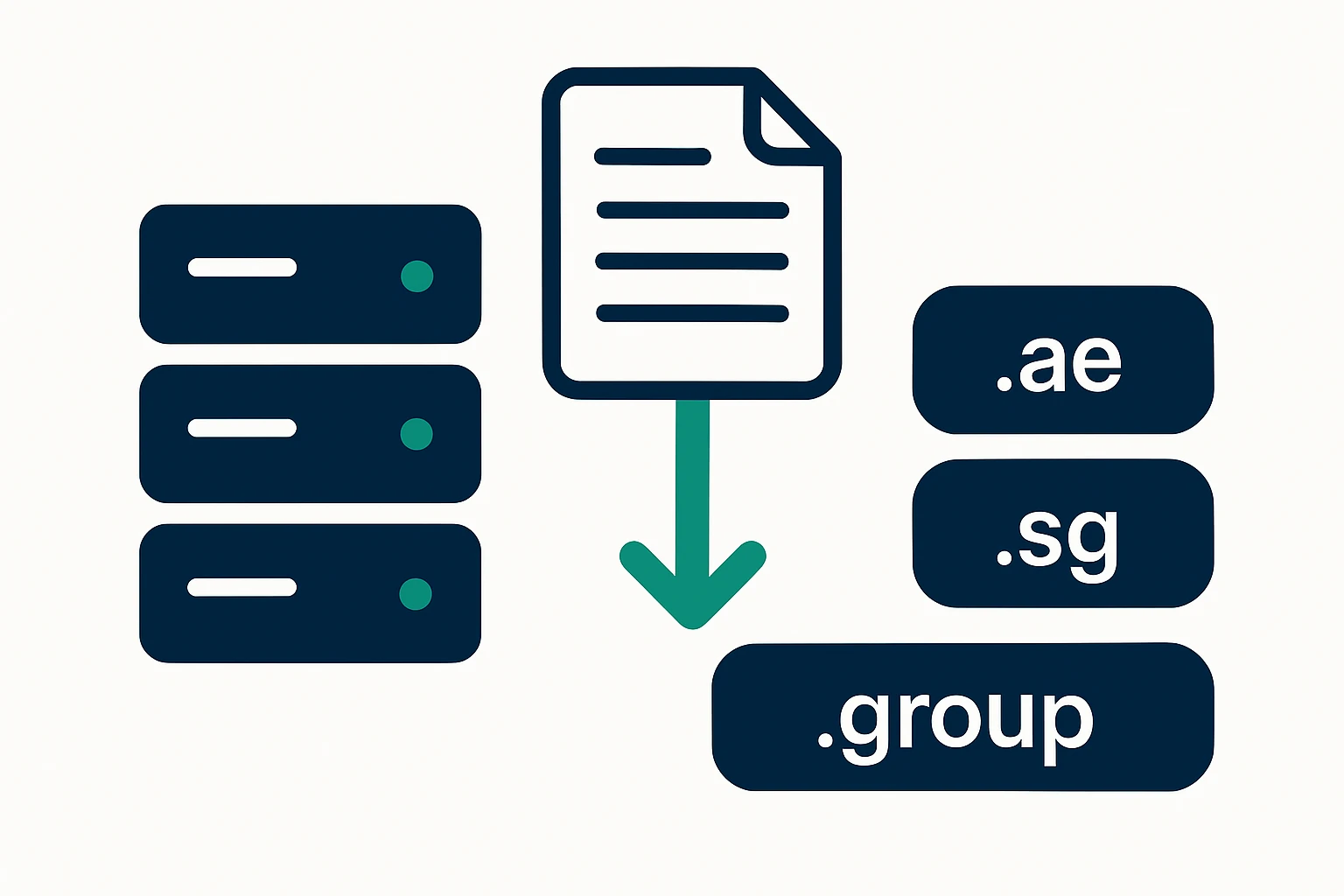
Enterprises today must defend a sprawling DNS footprint that spans on-prem networks, cloud environments, and partner or customer domains. As the attack surface expands, so does the need for timely, reliable domain data to protect users, applications, and critical infrastructure. Downloadable domain feeds - especially those covering namespaces like .ae, .sg, and specialized groupings such as .group - have become a practical tool in an enterprise’s DNS security and governance toolkit. This article examines how to approach these feeds in a way that aligns with enterprise-grade DNS infrastructure engineering, balancing security, compliance, and high availability.
Why downloadable domain feeds matter for enterprise DNS
Domain feeds serve three complementary purposes that are particularly relevant for large organizations:
- Asset discovery and inventory hygiene. External domain lists help security and network teams identify domains that may be active in the wild but not yet reflected in internal asset inventories. When feeds enumerate domains across namespaces such as .ae, .sg, and other TLDs, teams gain visibility into potential shadow assets and misconfigurations that could lead to data leakage or service disruption.
- Threat blocking at the DNS layer. By ingesting feeds that tag known malicious or suspicious domains, enterprises can implement proactive blocking or scraping policies at recursive resolvers or authoritative boundaries. This approach benefits security operations by reducing exposure to phishing, malware, and C2 infrastructure without waiting for endpoint updates.
- Compliance and governance. Industry frameworks such as SOC 2 and ISO 27001 require robust data provenance and change control. A disciplined feed-ingest process with clear provenance for each domain (source, timestamp, confidence) supports audit trails and risk management in DNS operations. For background reading on how threat intelligence feeds impact DNS security, see industry peers and standards bodies that document threat data provenance and integration best practices.
Real-world risk management in DNS increasingly hinges on credible feeds, and the quality of those feeds matters as much as the quantity. Leading DNS security vendors emphasize that threat intelligence feeds are most effective when they are timely, well scoped, and integrated into an automated workflow that respects your DNS architecture. Threat feeds are most valuable when paired with strong provenance and governance practices. (infoblox.com)
Understanding the namespace: focusing on .ae, .sg, and .group feeds
Namespaces like .ae (United Arab Emirates), .sg (Singapore), and niche groupings such as .group represent distinct registries with their own registration policies and operational characteristics. When organizations download and ingest feeds for these namespaces, a few realities emerge:
- Feed granularity and update cadence. Some feeds publish daily lists, others in near real-time or on-demand, and the quality of data can vary by namespace. An enterprise strategy should map update frequency to incident response SLAs and DNS cache behavior to avoid stale blocks or missed indicators.
- Format and metadata. Feeds come in CSV, TXT, or structured JSON lines, often accompanied by metadata such as source, confidence score, reason for inclusion, and effective dates. Normalizing these formats is essential for reliable ingestion into DNS tooling.
- Provenance and trust. In governance-heavy environments, every domain entry should carry attribution and a timestamp. As DNSSEC and cryptographic signing mature, ensuring the integrity of feed data becomes part of the pipeline rather than a one-off check. A credible reference point on DNS security and the role of threat intelligence feeds is the DNSSEC specification family and ecosystem coverage. RFC 4033 provides foundational context for DNSSEC within which feeds may operate to preserve data integrity. (rfc-editor.org)
For organizations evaluating external feeds, industry leadership indicates that phishing and abuse-related domain data should be considered alongside other security telemetry. The Anti-Phishing Working Group (APWG) maintains a broad repository of phishing-related indicators and trends that can help set expectations for feed quality and coverage. See APWG’s ongoing trends reporting for domain-use insights. APWG trends. (apwg.org)
How to design an ingestion pipeline for .ae, .sg, and .group feeds
An enterprise-grade ingestion pipeline should balance speed, accuracy, and operational risk. The following framework is intended to be practical for DNS operators who manage authoritative DNS, DNSSEC, and cloud-native DNS deployments.
- Ingest from multiple feeds (including official namespaces like .ae, .sg, and group-domain lists). Use a staged approach where raw data lands in a quarantine area before transformation.
- Normalize to a single canonical domain format (lowercase, trimmed whitespace, punycode for internationalized domains if needed) and unify with your internal asset inventory. This ensures deduplication and consistent policy application.
- Validate and enrich with provenance metadata (source, last-updated timestamp, confidence level). Where possible, enrich with threat context such as threat type (phishing, malware, C2) and associated advisories.
- Deploy with governance controls by applying a staged rollout in your DNS architecture. Start with a soft-block or allowlisting policy in a sandboxed environment before enforcing blocks in production. Consider TTL semantics to balance visibility and performance.
- Monitor and adapt with alerting on feed failures, data drift, or elevated false positives. Implement rollback mechanisms so updates can be reversed quickly if a feed proves problematic.
- Audit and report with immutable logs capturing data provenance, changes, and outcomes to satisfy SOC 2 ISO-style governance expectations. This is where a documented change-control process and periodic reviews prove their value.
To illustrate a practical path, consider how a large organization might pair these feeds with its existing DNS infrastructure (including authoritative DNS and cloud-native resolvers) and DNSSEC to maintain integrity and performance. The goal is not to flood your resolvers with every feed entry but to curate a cohesive, trusted feed set that informs policy decisions across the DNS stack. The process should be integrated with general DNS monitoring and logging practices to provide traceability for investigations and compliance exhibits. Threat intel integration remains a core capability of enterprise-grade DNS platforms, enabling consistent policy enforcement across environments. (infoblox.com)
A structured block: a practical deployment framework
To turn feeds into action, adopt a repeatable framework that aligns with the DNS operations lifecycle. The following block outlines a concrete, editor-friendly approach that a DNS engineering team can implement today:
- Feed-to-DNS Deployment Framework
- Ingest and Normalize: bring in feeds from multiple namespaces, including .ae, .sg, and .group, and normalize into a consistent domain format.
- Deduplicate and Enrich: remove duplicates, attach provenance and confidence metadata, and cross-reference with internal domain inventories.
- Policy and Staging: define blocklists vs allowlists, test in a staging zone, and validate with a small traffic window before full rollout.
- Deploy and Propagate: push approved blocks to authoritative DNS or recursive resolvers with appropriate TTLs and caching behavior.
- Monitor and Auto-Rollback: monitor feed health, false positives, and performance, roll back if policy drift is detected.
- Audit and Report: maintain a complete, auditable history of feed sources, changes, and outcomes for governance, risk, and compliance reporting.
In practice, many large teams couple this framework with a centralized security telemetry platform so that DNS blocks, endpoint events, and network observations all point to a common incident response workflow. When evaluating providers or feeds, consider compatibility with your DNS architecture (authoritative vs resolvers, Anycast deployments, and cloud-native DNS) as well as the ability to ingest feeds with standard data formats and APIs. For example, webatla offers a TLDs hub that makes it easier to browse and download domain lists by namespace. See webatla: .ae domains and webatla: List of domains by TLDs for reference.
Limitations, trade-offs, and common mistakes
No approach is perfect. The following considerations help frame realistic expectations and guide safer deployments:
- False positives and business impact. Broad domain feeds can inadvertently block legitimate domains, causing user experience or application access issues. Always validate with a staging window and maintain an allowlist for critical services.
- Feed quality varies by namespace. Not all feeds are created equal, some providers emphasize coverage, others emphasize accuracy. Diversify sources and implement quality gates to avoid over-reliance on a single feed. See industry discussions on threat intelligence quality and DNS integration.
- Change management and auditing are essential. DNS blocks are operationally sensitive changes. Keep detailed change records, align with SOC 2 ISO-type controls, and ensure that your governance model covers data provenance and access.
- Update cadence vs. DNS cache behavior. Frequent feed updates may demand shorter TTLs, which increases DNS query load. Balance update frequency with cache efficiency and network performance.
An important caveat is that phishing and abuse indicators evolve rapidly. APWG’s ongoing trends reports document the dynamic nature of domain-related threats and the need for timely, corroborated feeds to maintain security effectiveness. APWG Trends Reports. (apwg.org)
Practical considerations for the DNS engineer
From a technical perspective, a robust approach to downloadable domain feeds sits at the intersection of DNS security (DNSSEC integrity), scalable architecture (Anycast and cloud-native DNS), and operational governance (SOC 2 ISO-aligned controls). DNSSEC helps ensure the integrity and authenticity of DNS data as it traverses your network, which complements the trust placed in external feeds. For a concise overview of DNSSEC, refer to the RFCs that established the standard. RFC 4033 covers DNSSEC introduction and requirements. (rfc-editor.org)
Security vendors and DNS operators increasingly frame threat intel as a core component of PDNS and recursive filtering strategies. In practice, operational success comes from combining credible feeds with well-defined policy, automation, and monitoring. If you’re evaluating sources, consider how a provider supports data provenance, update cadence, and integration with your DNS platform and monitoring stack. The Infoblox threat intel page offers a pragmatic view of how real-world deployments harness feeds to improve detection and response. Threat intel in DNS. (infoblox.com)
Where to start: a practical, publisher-friendly path
Start with a small, controlled set of feeds that cover the namespaces you rely on most. Establish a staging environment that mirrors production DNS behavior and test updates against a representative synthetic traffic mix. Build a repeatable ingestion pipeline that includes: ingest, normalize, validate, deploy, monitor, and audit. This discipline helps you avoid common missteps and aligns with governance frameworks that many enterprises already pursue. For a curated source of namespace-specific domain lists, see webatla’s TLD pages, such as webatla: .ae domains and webatla: List of domains by TLDs.
Conclusion
Downloadable domain feeds for namespaces like .ae, .sg, and specialized groupings offer practical value for enterprise DNS operations, provided they are managed within a disciplined framework that emphasizes provenance, automation, and governance. By designing an ingestion pipeline that normalizes data, validates provenance, and deploys policy in a staged, auditable manner, security teams can extend their DNS protections without compromising reliability or compliance. In the end, the most effective DNS architecture treats external feeds as one among several layers of defense - complementing DNSSEC, Anycast, and cloud-native DNS to deliver resilient, auditable protection for modern enterprise networks.
Disclosure: The article references practical feed sources and a webatla namespace hub to illustrate how domain lists can be accessed and used in practice.