Introduction: DNS as a data-driven backbone for enterprise resilience
In large organizations, DNS operations extend far beyond translating names to IPs. The domain data that sits behind every lookup - ownership records, registration dates, and contact details - informs asset visibility, risk profiling, incident response, and regulatory compliance. To harness this data effectively, DNS teams are moving from legacy, manual lookups to modern, machine-readable registration data streams. The shift centers on two complementary data access paradigms: Registration Data Access Protocol (RDAP) and the long-standing WHOIS protocol. This article explains how enterprise DNS teams can operationalize RDAP and Whois data to strengthen inventory accuracy, security posture, and compliance programs. Note: this approach is most valuable when paired with authoritative DNS services, DNSSEC deployment, and robust monitoring, it is not a stand-alone solution. (Citations: ICANN’s RDAP overview, RFC 7482) (icann.org)
RDAP and Whois: what they are and why they matter for DNS operations
What is RDAP - and how does it differ from WHOIS?
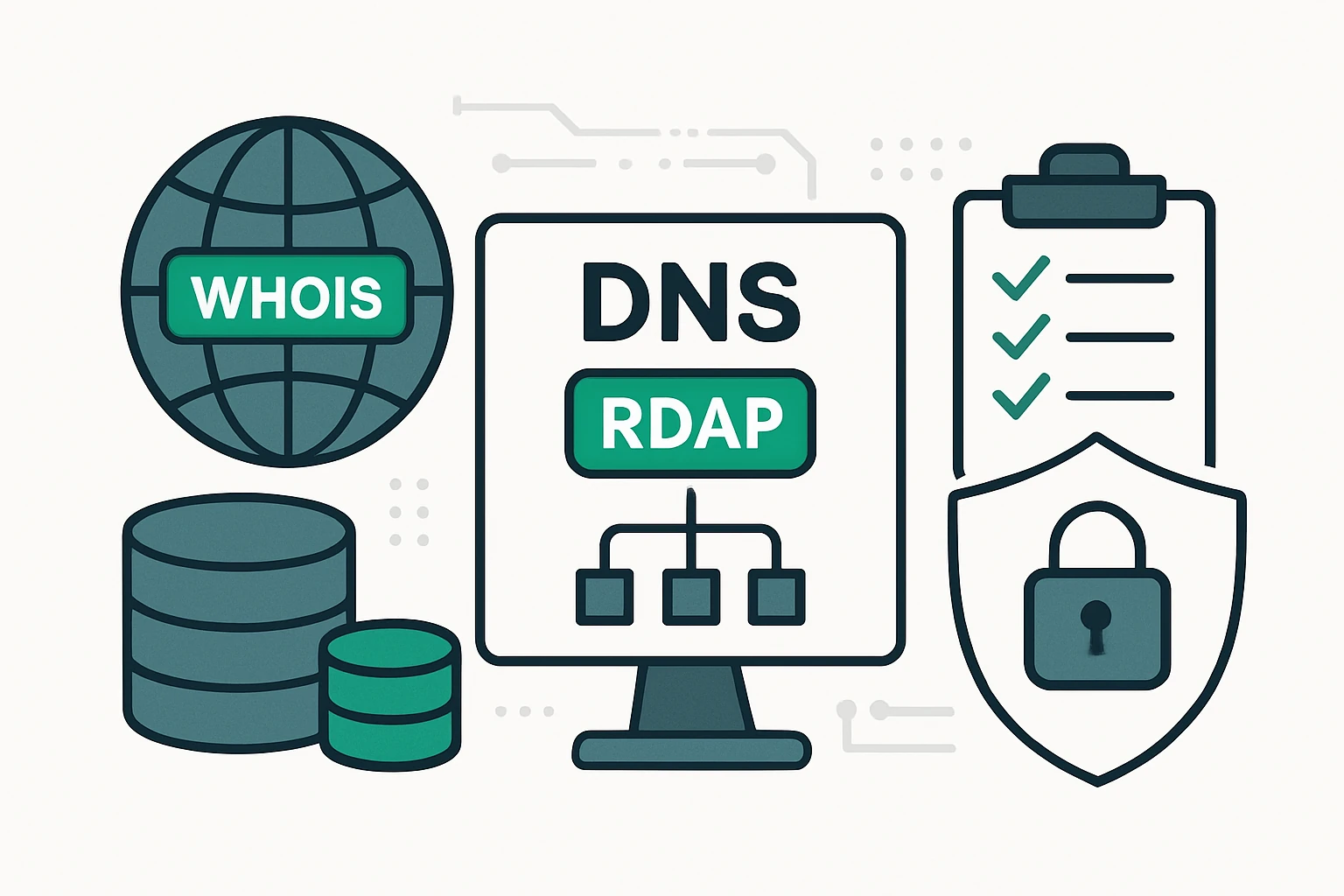
RDAP is a modern, protocol-based way to access registration data. It provides structured, machine-readable responses over HTTP/HTTPS, addressing many of the limitations of legacy WHOIS, such as inconsistent formats and rate limitations. ICANN and IETF standards activities underpin RDAP, with RFC 7482 defining the RDAP query format and related semantics. For enterprise teams, RDAP enables automated ingestion of domain data into security orchestration, asset management, and compliance tooling. Key sources and standards include ICANN’s RDAP program and the RFC 7482 specification. (icann.org)
Why RDAP matters for enterprise DNS
Beyond being the technical successor to WHOIS, RDAP supports better governance of who can access what data (with policy controls) and offers richer, structured data suitable for automation. For DNS operations, this translates into more reliable domain inventories, faster validation of ownership during incident response, and clearer audit trails for compliance reporting. The ongoing transition in the domain ecosystem, driven by ICANN policy and IETF standards, makes RDAP the practical default for modern DNS teams.
From a security and governance perspective, RDAP enhances data quality and retrieval reliability, which are critical when you’re mapping assets, tracking changes, and aligning with internal security controls. See ICANN’s RDAP overview and the RDAP standard for details on data access and format. (icann.org)
Building a modern data foundation for DNS: asset visibility, risk, and compliance
Effective enterprise DNS relies on three intertwined pillars: accurate asset inventory, risk-aware domain data, and auditable compliance records. RDAP and Whois data play a central role in each pillar:
- Asset inventory: A complete view of registered domains and related contacts helps you identify shadow assets, monitor changes, and reduce blind spots in DNS configurations and firewall rules.
- Risk assessment: Registration dates, registrant updates, and domain status changes feed risk scoring, enabling proactive monitoring for suspicious activity or domain hijacking attempts.
- Compliance and auditing: Clear, auditable data supports SOC 2 and ISO compliance processes, as well as internal governance reviews for domain-related risk.
In practice, RDAP’s structured responses enable automated enrichment of your DNS dashboards, while Whois data serves as a confirmation layer during investigations or asset verifications. The result is a more resilient DNS operation that can respond quickly to incidents and regulatory inquiries. For teams that operate across multiple registries and TLDs, the standardized RDAP interface becomes the common integration point for security tooling, CMDB-like asset catalogs, and incident response playbooks. (icann.org)
Practical workflows: from registration data to DNS operations
Below is a pragmatic workflow that translates RDAP and Whois data into tangible DNS governance and security improvements. Each step links data access to concrete operational outcomes.
1) Establish a single source of truth for domain data
Centralize registration data from RDAP and WHOIS feeds into a domain inventory repository. Normalize fields (e.g., registrant name, registrant organization, contact email) and reconcile with internal asset data (DNS zones, hosting providers, and third-party services). This creates a defensible baseline for change detection and compliance reporting. Tip: use RDAP’s structured payloads to automate mapping to your internal schema. (icann.org)
2) Automate change detection and alerting
Set up automated comparisons between the domain inventory and registration records to flag ownership changes, new registrations, or status transitions. Integrate alerts into your security operations center (SOC) so suspicious activity is surfaced alongside DNS anomalies (e.g., anomalous DNS query patterns or unusual registrar changes). RDAP’s machine-readable responses enable reliable automation. (icann.org)
3) Enrich DNS risk scoring with data provenance
Use registration data to contextualize DNS risk. For example, a recently updated registrant or a registrar with a history of domain disputes might warrant tighter monitoring or additional validation steps before DNS changes propagate. This complements DNSSEC deployment by grounding trust in verifiable ownership records. RFC 7482 describes the protocol’s structured nature, which makes automation feasible. (datatracker.ietf.org)
4) Support incident response with rapid ownership validation
During a security incident, operators can query RDAP/WHOIS data to confirm domain ownership and contactability, compare with internal registries, and determine whether a domain is under legitimate control. The combination of RDAP’s standardized data and policy-based access controls helps reduce investigative latency. ICANN’s RDAP guidance and the RFC specification provide the technical basis for these workflows. (icann.org)
5) Demonstrate compliance readiness
Audit-ready documentation benefits from immutable data trails: who registered a domain, when a change occurred, and who was contacted. RDAP’s structured responses support automated logging and the generation of evidence for SOC 2 and ISO audits. NIST’s DNS deployment guidance further reinforces the importance of data integrity and traceability in enterprise DNS. (csrc.nist.gov)
A practical framework for harnessing registration data in DNS operations
Use the following framework to translate registration data into action within DNS infrastructure engineering. This concrete, repeatable approach helps teams scale data-driven DNS governance.
- Data ingestion – ingest RDAP and WHOIS data from registries and registrars, normalize fields, and map to internal asset models.
- Data enrichment – enrich domain records with DNSSEC status, zone file references, and hosting/provider data to assess trust and exposure.
- Change detection – implement periodic reconciliation and alerting for ownership changes, registrar transfers, and status updates.
- Risk scoring – apply a scoring rubric that weights ownership stability, historical disputes, and registrar reputation to prioritize investigations.
- Compliance reporting – auto-generate audit trails, change histories, and evidence packs for SOC2/ISO controls and internal governance.
This framework aligns with industry guidance on DNS security and data governance. RDAP’s structured responses are especially well-suited for automation in asset management and incident response workflows. See ICANN’s RDAP program for policy and data-access considerations, and RFC 7482 for the formal query structure. (icann.org)
Limitations, trade-offs, and common mistakes
While RDAP and Whois data offer substantial value, several limitations require attention to avoid brittle implementations:
- Privacy and data protection constraints: GDPR and other privacy laws affect how registration data can be accessed and stored, especially for bulk or automated access. This makes policy design critical and often necessitates data minimization and access controls. See ICANN’s GDPR-related discussions for context and policy nuances. (gnso.icann.org)
- Incomplete global coverage: Not all registries implement RDAP uniformly, so some data gaps may persist, requiring fallback to legacy sources or manual verification. RFC and ICANN guidance describe the evolving landscape and conformance considerations. (datatracker.ietf.org)
- Data quality and consistency: RDAP data quality can vary by registrar and TLD, so automated normalization and reconciliation with internal data are essential to avoid false positives. Industry deployment guides from NIST emphasize securing DNS while ensuring accurate data inputs. (csrc.nist.gov)
- Rate limits and access controls: Bulk queries may be restricted by registries, design access policies and caching strategies to stay within acceptable use terms while meeting operational needs. GDPR discussions and policy analyses provide practical guardrails. (gnso.icann.org)
- Operational complexity: Integrating registration data into existing DNS tooling requires cross-team coordination (security, networking, compliance, and IT operations) and careful change-management processes.
Common mistakes to avoid include treating RDAP as a pure data source without governance, over-indexing on a single data feed, and neglecting privacy/compliance considerations when enabling bulk data access. A disciplined approach - clear ownership, documented policies, and automated validation - helps mitigate these risks. For governance perspectives, see policy discussions around RDAP and WHOIS with ICANN and IETF references. (icann.org)
The data you can access today: bulk domain data and responsible usage
Organizations sometimes seek bulk domain lists to inform inventory scoping, threat hunting, or policy testing. While RDAP and targeted lookups are the most compliant routes for ongoing operations, bulk data can be useful for planning and benchmarking when used within a compliant framework and with appropriate permissions. When considering bulk data such as download list of .com domains or download list of .de domains, it’s important to understand both availability and regulatory boundaries. Many data providers offer bulk lists tied to specific TLDs, but they must be used in line with privacy and legal requirements. For teams evaluating these options, it helps to anchor bulk data strategies to RDAP-enabled workflows and to consult policy guidance from registries and ICANN. The official RDAP framework and GDPR discussions provide the guardrails you need as you scale. (datatracker.ietf.org)
For teams seeking direct access to a combined RDAP/WHOIS data source and ongoing updates for enterprise use, consider solutions that provide compliant API access and robust auditing capabilities. The RDAP & WHOIS Database offering describes how structured access can feed DNS governance workflows, and it can be a foundational component of your enterprise DNS data strategy. If you’re exploring bulk domain lists for planning, see the internal team resources and data catalogs that host download list of .com domains and download list of .de domains as part of a broader domain data program.
Integrating with DNS infrastructure engineering: a practical view
Enterprise-grade DNS requires more than data access, it requires an adaptable, scalable infrastructure. RDAP/WHOIS data complements authoritative DNS, DNSSEC, and cloud-native DNS architectures by providing visibility into registration-level changes that influence security controls and policy enforcement. When you couple registration data with real-time DNS health monitoring, you get a fuller picture of risk and reliability - from zone transfers and DNSSEC key management to anycast deployments and cloud DNS orchestration. Industry guidance from NIST on DNS deployment emphasizes building a secure, trustworthy DNS foundation, with data provenance playing a central role in governance and incident response. (csrc.nist.gov)
As you adopt these data streams, ensure your governance model includes clear roles for data access, retention limits, and a defined process for handling requests under privacy regulations. The transition from WHOIS to RDAP is ongoing and policy-driven, so align your operational practices with both standards and regulatory expectations. (icann.org)
Conclusion: turning registration data into DNS resilience
RDAP and Whois together offer a powerful foundation for enterprise DNS - enabling precise asset visibility, proactive risk management, and auditable compliance. The right approach combines structured RDAP data with disciplined governance, secure DNS design (including DNSSEC where feasible), and integrated monitoring. By embedding registration data into your DNS workflows, you can reduce blind spots, speed up investigations, and demonstrate control to auditors and regulators. The ongoing evolution of RDAP standards and policy - backed by IETF and ICANN - means this is a strategic, forward-looking capability for any enterprise DNS program.
For teams seeking a practical, enterprise-grade data source to drive these capabilities, consider solutions that provide compliant RDAP/WHOIS access and robust logging. The RDAP & WHOIS Database and related domain data resources can serve as reliable anchors in your data strategy, while cross-referencing with authoritative DNS infrastructure guidance from NIST can help ensure you’re building resilience, not just visibility.